Wheel Loader vs Excavator for Material Handling: Fleet Optimization Guide
Picture a sprawling recycling facility, concrete plant, or aggregate yard at peak operation. Semis are backing up in a continuous line, production hoppers are running empty, and thousands of tons of loose material need to be sorted, stacked, and loaded before the closing whistle. In the middle of this high-stakes choreography sits the ultimate equipment dilemma: do you assign a wheel loader or an excavator to keep the operation running smoothly?
What fleet managers and project supervisors frequently get wrong is looking strictly at bucket capacity or machine horsepower when weighing a wheel loader vs an excavator for material handling. They overlook how the physical layout of the site, travel distances, and the angle of approach radically alter the efficiency of each machine. Choosing the wrong piece of equipment for your yard layout is a guaranteed way to drive up cycle times, accelerate tire or track wear, and burn through thousands of dollars of extra fuel.
Understanding the operational differences between these two heavy-duty workhorses goes far beyond simple digging capability. Making the right choice directly optimizes your site logistics, controls daily machine depreciation, lowers your cost-per-ton metrics, and ensures you hit your daily production targets without bottlenecking your entire fleet.

The Mobility Constraint of Tracked Machinery
You are managing an extensive aggregate yard where the sand, gravel, and crushed stone piles are spread hundreds of feet apart across a rough gravel lot. A line of commercial dump trucks is waiting at the main gate, and they need to be loaded from different piles as quickly as possible.
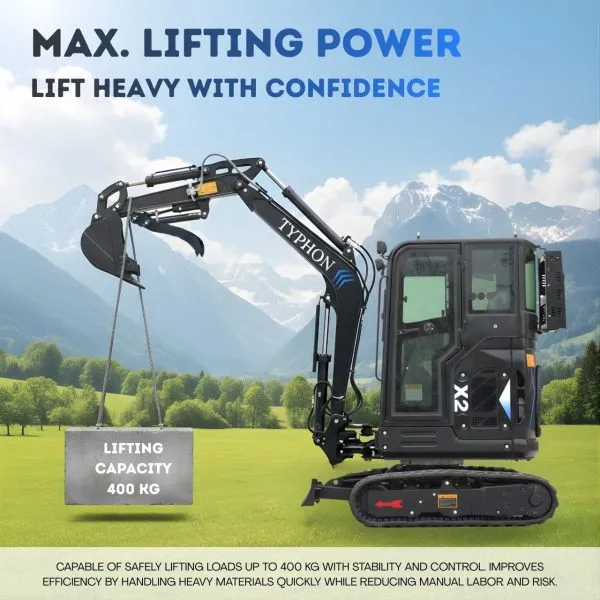
If your primary machine for this task is a standard crawler excavator, your operation will face an immediate, frustrating limitation. Excavators are fundamentally designed to sit in one fixed spot, dig, pivot, and dump. When an excavator has to constantly travel back and forth across a massive yard to reach different stockpiles, its productivity plummets.
The steel tracks or rubber pads of an excavator move slowly, typically topping out at less than 4 miles per hour. Moving long distances causes massive frictional wear on the undercarriage components, leading to thousands of dollars in premature track maintenance. In real-world yard conditions, forcing an excavator to act as a mobile transporter results in slow cycle times, high fuel burn as the engine works to move the heavy undercarriage, and an increasingly frustrated line of truck drivers waiting at the scale. The impact is felt everywhere—from reduced yard safety due to blind spots during tracking to a drop in overall daily volume.
To overcome this mobility hurdle, you have to shift your focus to a platform built explicitly for high-speed ground transport.
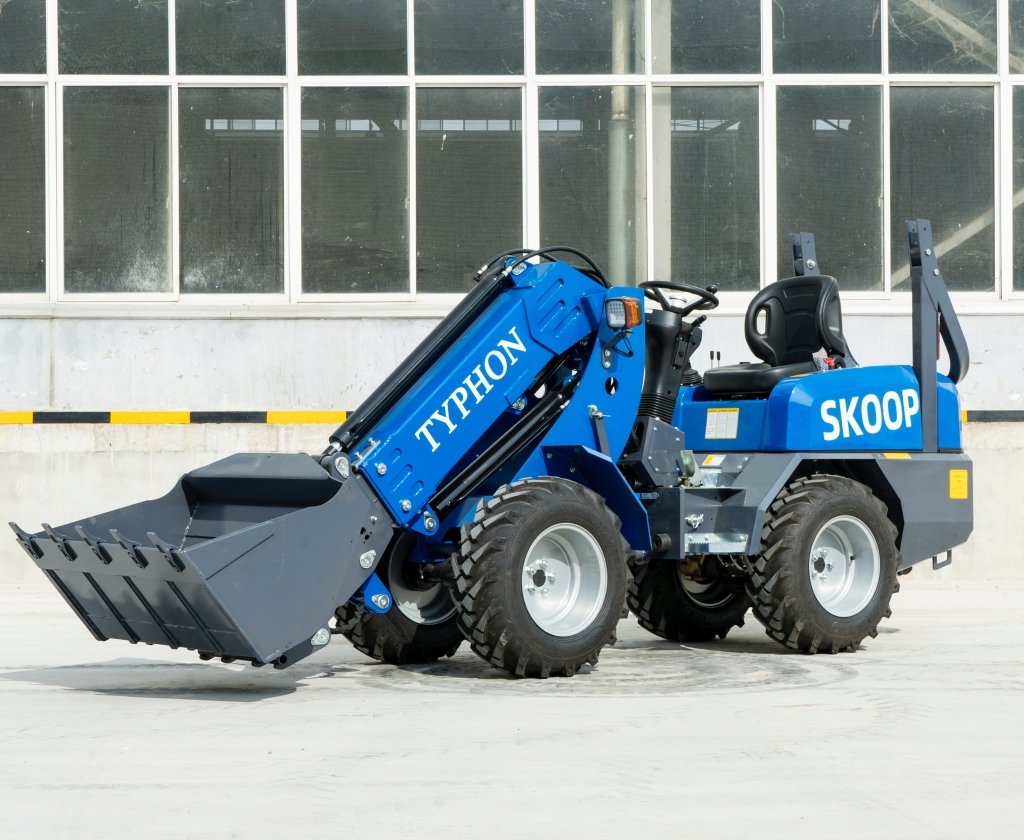
High-Speed Bulk Transports on Wheel Loader
When your material handling tasks require rapid movement across substantial distances, the wheel loader completely transforms your workflow.
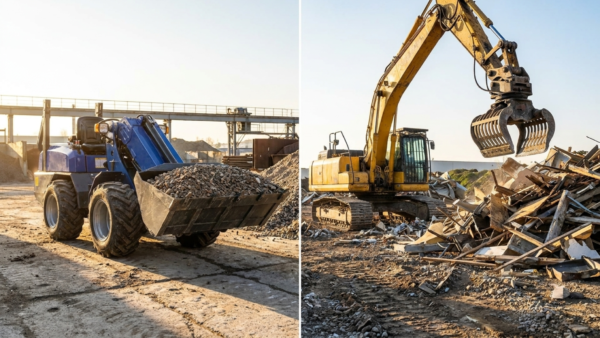
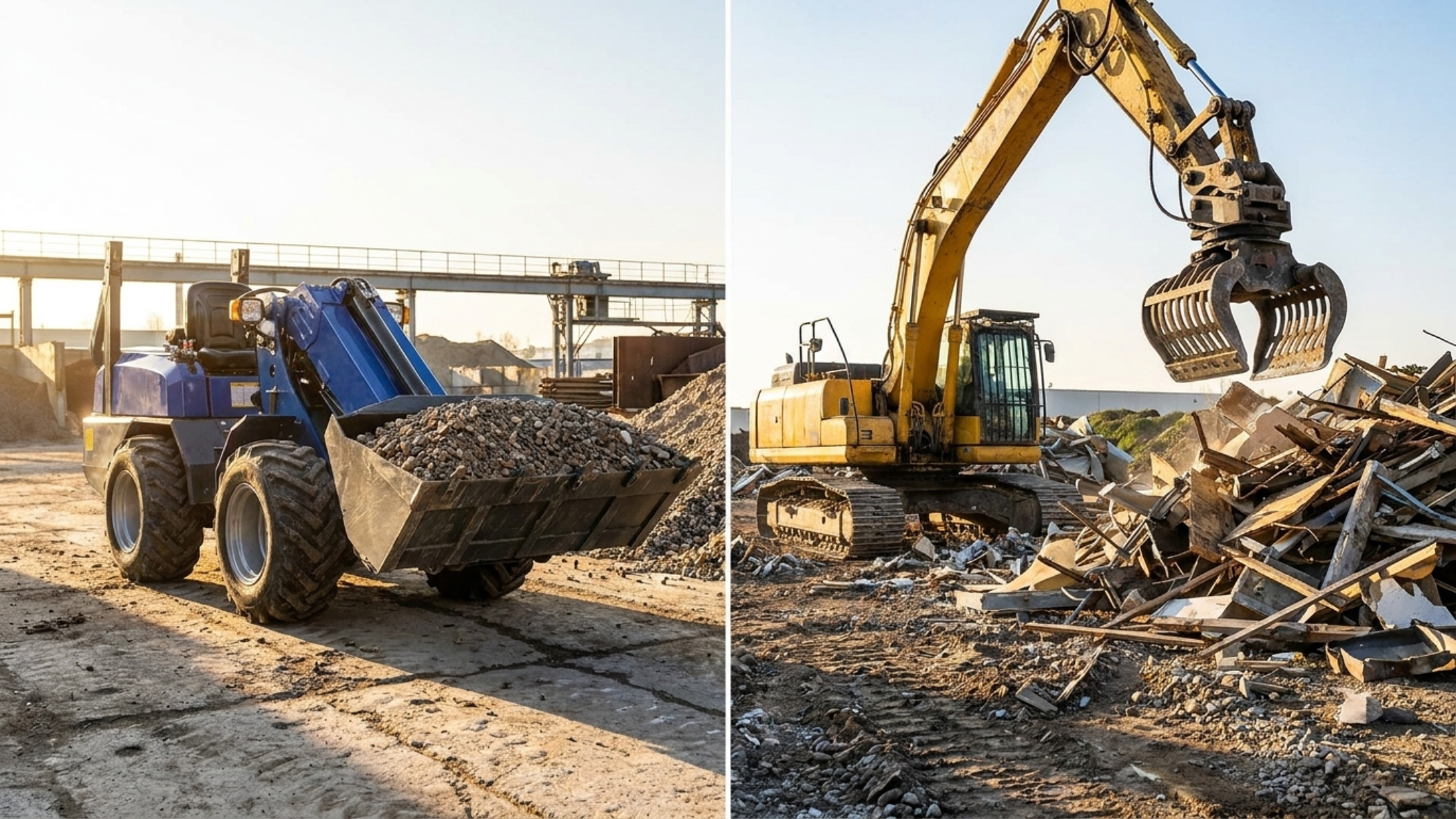
Instead of crawling on tracks, a wheel loader rides on massive, heavy-duty pneumatic tires and utilizes an articulated steering system. This allows the machine to easily reach travel speeds of 12 to 25 miles per hour across a busy job site. The loader operates via a dynamic “load-and-carry” cycle: it drives forward into a stockpile with immense momentum, fills its high-capacity bucket, and immediately transports that material hundreds of feet away to a hopper or an awaiting haul truck.
In a real-world yard scenario—such as a bulk composting facility or a highway construction staging area—a single wheel loader can manage multiple stockpiles simultaneously. It can scoop three tons of organic mulch, race across the yard to fill a customer’s truck, and pivot back to the main pile before an excavator could have even tracked halfway across the lot. The impact on your workflow is clear: significantly faster cycle times, drastically reduced undercarriage maintenance, and a highly agile operation that can pivot to different tasks instantly.
However, high-speed mobility is no longer the winning factor when your material handling must happen within a highly restricted footprint or from a stationary, elevated position.
The Power of Stationary Precision
The load-and-carry efficiency of a wheel loader breaks down entirely when the jobsite dynamics change from wide-open horizontal movement to tight, vertical, or deep-level material extraction.
Imagine you are running a high-volume demolition recycling yard or a deep sand pit where material must be extracted from a deep trench or reached over a high structural wall. A wheel loader cannot dig below its own wheels effectively, and it requires a wide, clear path to approach a pile, turn around, and dump. If the work area is cramped, muddy, or requires reaching over obstacles, a wheel loader will spin its tires, lose traction, and struggle to fill its bucket safely.
This is the exact environment where an excavator becomes the superior choice for material handling. By utilizing its 360-degree rotating cab, boom, and stick assembly, an excavator can remain completely stationary while reaching down into pits, over barriers, or high up into industrial shredders. In real-world conditions, an operator can position an excavator on a stable bench overlooking a massive pile of concrete debris. The machine can continuously sort, lift, and load material into a crusher without moving its tracks an inch. This eliminates tire slippage, keeps the machine out of dangerous muddy, stable zones, and provides unparalleled precision when separating materials.
As your daily intake of material scales up to maximum capacity, the differences between these two approaches dictate your entire production volume.
Scaling Up to High-Volume Production Loading
When your facility shifts from intermittent material handling to continuous, high-volume production loading—where a single hour of downtime can cost thousands of dollars—the scale of your machinery must step up accordingly.
In ultra-high-volume environments like large quarries or massive rail yards, the choice between a wheel loader vs. an excavator for material handling hinges entirely on the site layout and the haul fleet setup. If you are loading a continuous line of rigid-frame quarry trucks from a single, static rock face, a large production-class excavator is often preferred. The excavator sits high on the muck pile, reaches down to scoop blasted rock, and drops it cleanly into the truck bed below. This top-down loading angle reduces the risk of rocks spilling onto the truck cab and minimizes wear on the truck’s suspension.
Conversely, if the blasted rock needs to be blended from various sections of the pit or moved across the quarry floor to a primary crusher, a large wheel loader takes the crown. The limitation of previous, smaller machines is overridden by sheer scale. These high-volume loaders carry buckets holding up to 10 or 15 cubic yards of material per scoop. The operational impact is staggering: a massive wheel loader can fill a highway-legal dump truck in two quick passes, ensuring the haul fleet stays on the move.
The trade-offs at this scale are intense. Large wheel loaders consume immense amounts of fuel and can destroy expensive tires on sharp rocks if tire protection chains aren’t installed. Large excavators require massive flatbed transport to move and have a fixed operational footprint. Understanding these massive financial variables requires looking at specialized or alternative equipment setups.
The Material Handler: A Highly Specialized Alternative
Sometimes, the standard design of a conventional construction wheel loader or standard excavator is simply not flexible enough to handle unique industrial materials like scrap metal, loose logs, or baled waste.
When your operation demands maximum vertical reach, continuous high-speed sorting, and crystal-clear operator visibility over high structures, a specialized material handler represents the ultimate alternative approach. A material handler is a hybrid evolution of the excavator platform. Instead of a standard short boom and digging bucket, it features a highly elongated, straight boom, a dropped-nose stick, and a specialized hydraulic attachment like an orange-peel grapple or magnet. Most importantly, it features a hydraulically elevating cab that lifts the operator up to twenty feet into the air.
Compared to a standard wheel loader, which must drive blindly up to a high-sided scrap hopper, a material handler can sit stationary next to a railcar, elevate its cab so the operator can look directly inside, and precisely sort steel scrap with surgical precision. A perfect real-world use case is a busy maritime port or river barge terminal. The material handler sits on the dock, reaches deep into the hull of a ship, grabs massive loads of loose materials, and swings them directly into a sorting conveyor.
While it lacks the long-distance transport speed of a wheel loader, its vertical reach and static efficiency make it irreplaceable for specialized recycling and port operations.
Decision-Making Guide: Choosing Your Workhorse
Bringing everything together into a practical daily action plan requires looking honestly at your site’s physical constraints and your primary material handling metrics.
Do not base your multi-thousand-dollar equipment investment on extreme, rare job scenarios. Instead, focus entirely on your daily tasks and yard logistics by using a clear comparison framework:
| Operational Factor | Wheel Loader | Excavator |
| Primary Movement | High-speed horizontal transport (Load & Carry) | Stationary vertical reach (Dig, Rotate & Dump) |
| Travel Speed | 20 to 25 mph | 2 to 4 mph |
| Best Site Layout | Wide-open yards with spread-out stockpiles | Tight, congested spaces or fixed processing lines |
| Digging Capability | Limited to ground level and upward scooping | Excellent below ground level and over barriers |
| Ground Impact | Low track wear; potential tire spinning on sharp rocks | High track wear if traveled; highly stable on mud |
| Cycle Pattern | V-shape driving path requiring clear floor space | 180 or 360-degree pivoting from a fixed point |
To make your final decision, apply this simple logic: If your material handling process requires moving loose product more than 50 feet from point A to point B, or if you need to load trucks from multiple piles across a large lot, buy a wheel loader. The time saved in transit will easily translate into lower operating costs and higher efficiency.
If your material handling is focused on sorting piles in a confined space, feeding a fixed conveyor or hopper from a single position, or pulling material out of deep pits and railcars, buy an excavator. Protect your long-term value by pairing your machine with a hydraulic quick coupler, allowing you to quickly change bucket sizes or add specialized grapples as your material processing needs evolve.
Conclusion
In the debate of a wheel loader vs. excavator for material handling, there is no universally superior machine. The winning choice is determined entirely by how material flows through your unique jobsite.
A wheel loader remains the undisputed champion of speed, horizontal transport, and rapid truck loading across wide-open spaces. An excavator stands as the definitive master of stationary power, vertical reach, and precise material sorting within tight boundaries. Prioritizing your site layout, transport distances, and daily tonnage targets over basic machine size specs ensures your fleet operates at peak efficiency.
By analyzing your workflow through this practical lens today, you will choose the exact machine that slashes your cycle times, preserves your undercarriage or tires, and drives maximum profitability into your bottom line.
Frequently Asked Questions
What is a wheel loader vs. an excavator for material handling?
It is the operational comparison of using a highly mobile, wheeled machine with a front-mounted bucket (wheel loader) versus a tracked machine with a 360-degree rotating cab and hydraulic boom (excavator) to move, sort, and load loose bulk materials.
How do I choose the right machine for my material handling yard?
Analyze your travel distances and site layout. Choose a wheel loader if materials are spread out across a large area and require fast transit. Choose an excavator if your workspace is highly restricted and requires sorting or reaching over tall structures from a fixed position.
What is the best machine for loading dump trucks quickly?
For wide-open aggregate yards, a wheel loader is the best machine because it can quickly scoop material, drive directly to the truck, and dump over the side in a rapid V-pattern cycle. For tight spaces or deep pits, an excavator is superior as it loads from a fixed position.
Is an excavator worth it for pure material handling tasks?
Yes, an excavator is highly worth it if your material handling involves sorting diverse debris, processing scrap, or clearing out deep railcars and barges where a wheel loader cannot physically reach or navigate safely.
What is the difference between a wheel loader and a specialized material handler?
A wheel loader moves materials horizontally across a yard using tires and a front bucket. A specialized material handler is an excavator-based machine with a raised cab and an extra-long boom designed exclusively to sort and lift materials vertically from a fixed position.