Agricultural Uses for Compact Wheel Loaders
Few machines earn their keep on a farm quite like the compact wheel loader. It shows up for the heavy lifting at sunrise, handles a dozen unrelated tasks before lunch, and keeps working through every season of the year. For farmers, agricultural business owners, and equipment buyers weighing their next purchase, understanding the agricultural uses for compact wheel loaders reveals just how much value a single, well-chosen machine can deliver across an entire operation.
This guide walks through the wide range of farming and agricultural applications where compact wheel loaders prove their worth, from moving hay and handling feed to managing manure, clearing land, and supporting livestock. We will also look at what makes these machines so well suited to farm environments, so you can decide with confidence whether one belongs in your equipment lineup.
What Makes Compact Wheel Loaders a Natural Fit for Farms
Before exploring specific tasks, it helps to understand why compact wheel loaders have become such a trusted part of modern farming equipment. The answer comes down to three core strengths that align almost perfectly with the realities of agricultural work. The first is attachment versatility. A compact wheel loader is rarely a single-purpose tool. With a quick-attach coupler, the same machine that carried a bucket of feed in the morning can switch to pallet forks, a bale spear, a grapple, or a sweeper in a matter of minutes. That flexibility lets one machine replace several pieces of dedicated equipment, which is a meaningful advantage on a farm where budgets are tight and storage space is limited.
The second strength is maneuverability in tight spaces. Farms are full of confined areas where larger equipment simply cannot operate efficiently. Crowded barn alleys, narrow gates, packed feed lots, and busy yards all demand a machine that turns sharply and positions loads with precision. Compact wheel loaders are built with articulated steering and a small footprint, allowing operators to work confidently around livestock, buildings, and stored materials without the constant repositioning that a bulkier loader would require. At the same time, their articulated design keeps the bucket tracking straight ahead during turns, which makes precise loading far easier than it is with a skid steer in many situations.
The third strength is the ability to handle varied terrain. A working farm rarely offers smooth, level ground. Operators contend with mud, gravel, packed dirt, sloped pasture, and uneven yards every day. Compact wheel loaders ride on rubber tires that roll smoothly across these surfaces, cover ground quickly, and cause less disturbance to soil and turf than tracked machines. Their ground clearance and stability let them move loads across the property efficiently, whether that means hauling feed from a storage building to a distant pen or carrying materials across a field to a work site. Together, these qualities explain why compact wheel loader farm applications span nearly every corner of an agricultural operation.
Moving and Handling Hay Bales
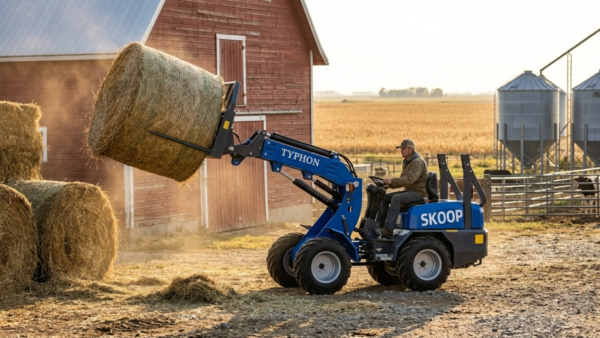
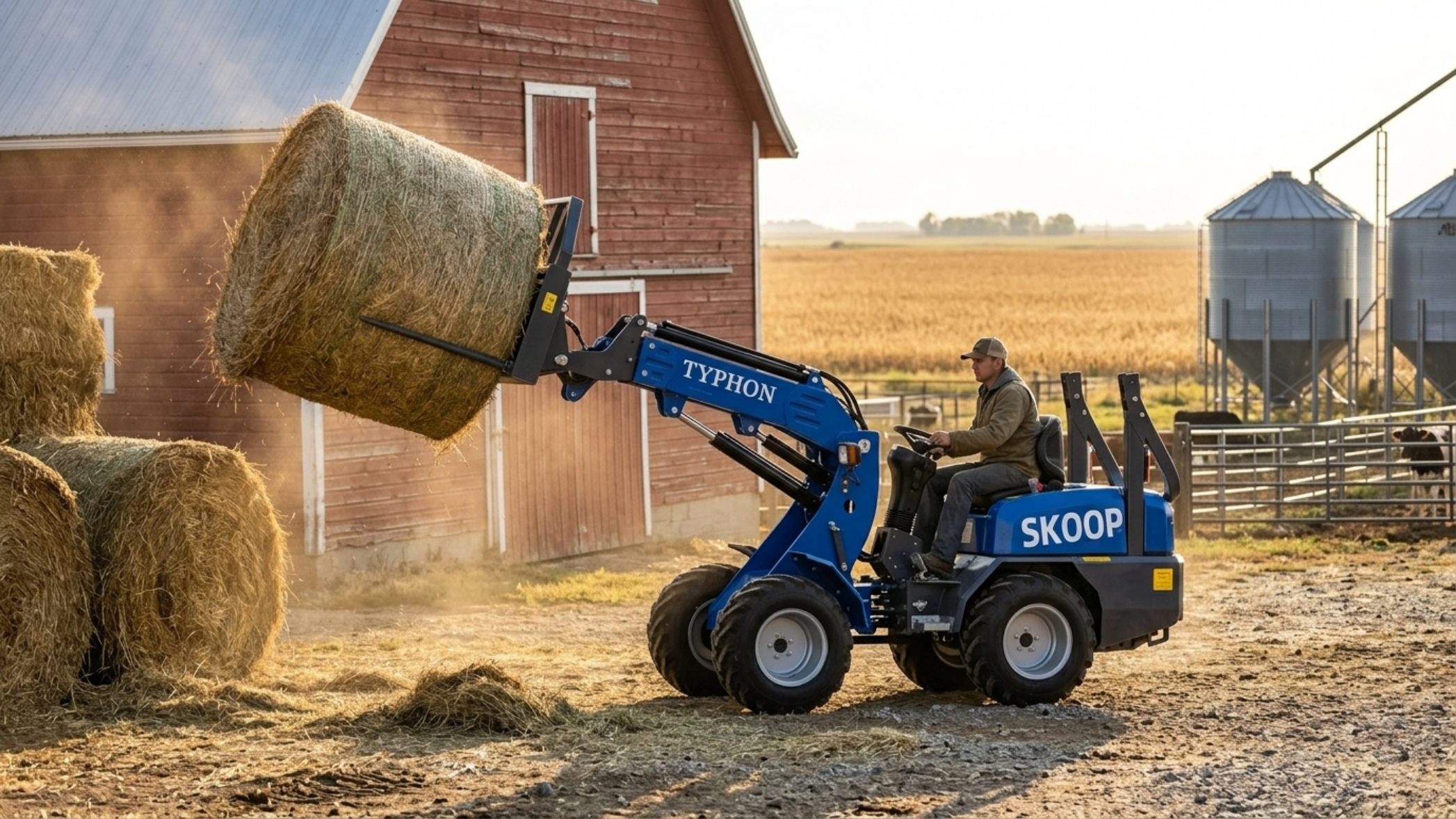
Hay handling is one of the most common and demanding jobs on any livestock or forage operation, and it is where a compact wheel loader truly shines. Large round and square bales are heavy, awkward, and frequently need to move between fields, storage areas, and feeding locations throughout the year. Fitted with a bale spear or bale-handling attachment, a compact wheel loader lifts, transports, and stacks bales with speed and control that hand labor and smaller equipment cannot match.
The machine’s lift capacity and reach allow operators to stack bales several layers high, making the most of limited storage space inside barns or under cover. When feeding time comes, the same loader carries bales directly to feeders or pastures, saving hours of labor and reducing the physical strain on the people doing the work. Because the loader handles bales gently and precisely, it also reduces waste from dropped or damaged bales, which protects the value of a crop that represents real money and many hours of effort. For any operation that depends on hay, this single capability often justifies the investment on its own.
Feed Handling and Daily Livestock Feeding
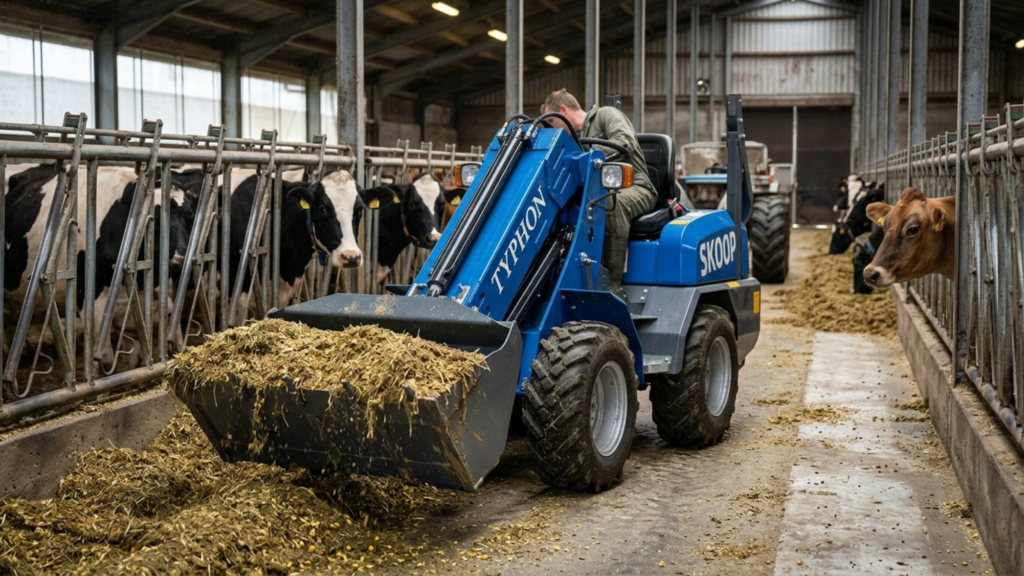
Beyond hay, compact wheel loaders play a central role in the daily routine of feeding livestock. Feed handling involves moving silage, grain, mixed rations, and other materials from storage to the animals, often multiple times a day, every day of the year. This is repetitive, time-sensitive work, and the efficiency of the machine doing it has a direct effect on labor costs and overall productivity.
With a bucket attachment, a compact wheel loader scoops and transports silage from bunkers or loads feed into mixers quickly and cleanly. Its precise hydraulic controls let operators dispense the right amount with minimal spillage, and its maneuverability allows it to work in the close quarters of feed alleys and barns without disturbing the animals. For dairy and beef operations especially, where feeding consumes a large share of daily labor, a loader that streamlines this task delivers value that compounds across every single day of the year. The reliability of having a machine that starts and performs this work without fail is exactly what keeps a feeding routine on schedule.
Manure Management and Barn Cleaning
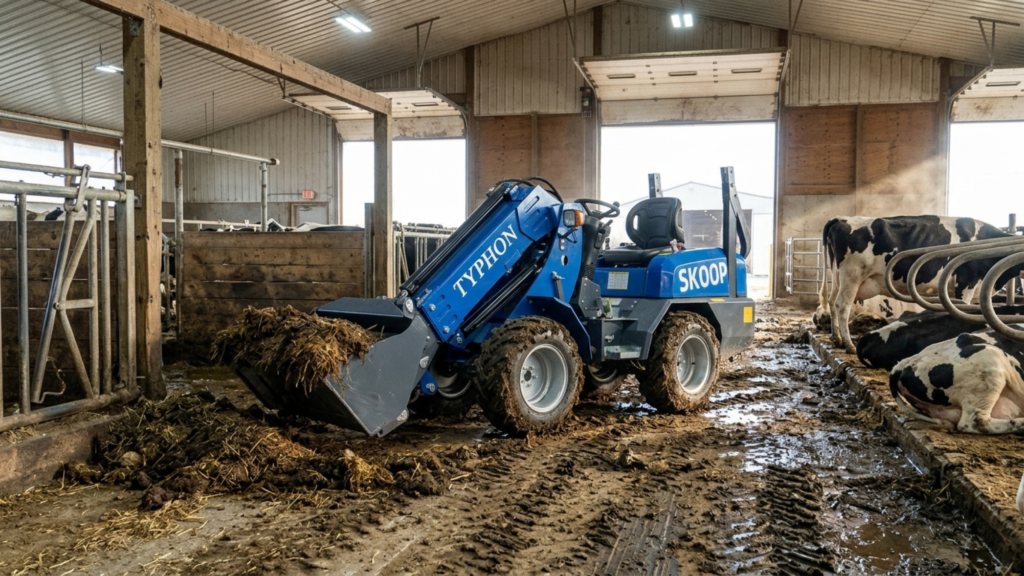
Manure management is an unavoidable and essential part of livestock farming, and it is rarely anyone’s favorite job. A compact wheel loader makes this work faster, cleaner, and far less labor-intensive. Equipped with a bucket or a grapple, the machine scrapes, scoops, and hauls manure out of barns, pens, and holding areas efficiently, helping maintain the clean, healthy conditions that protect animal welfare and comply with environmental requirements.
The loader’s strength and capacity let it move large volumes quickly, whether that means cleaning out a barn between groups of animals or loading manure into a spreader for application to fields. Its maneuverability is a genuine asset here, since barn cleaning often happens in tight, enclosed spaces where a larger machine would struggle. By turning a grueling manual task into an efficient mechanized one, a compact wheel loader improves both the working conditions on the farm and the consistency of the manure-handling routine, which in turn supports better soil health when that material returns to the fields as fertilizer.
Loading and Unloading Materials
Across the farming year, an operation constantly moves materials in and out, and a compact wheel loader handles this loading and unloading work with ease. Trucks and trailers arrive carrying feed, fertilizer, seed, fencing supplies, and countless other goods, and all of it has to be unloaded and put away. The loader, fitted with pallet forks or a bucket, lifts pallets and bulk materials off trucks and transports them to storage quickly and safely.
When it is time to ship products out or move supplies to another part of the operation, the same machine loads trailers with equal efficiency. This versatility makes the compact wheel loader an everyday workhorse for material handling, reducing the manual labor and the time that loading tasks would otherwise demand. For any agricultural business that receives regular deliveries or moves significant volumes of product, having a dependable loader on hand keeps the whole operation flowing smoothly and prevents the bottlenecks that slow everything down.
Land Clearing and Site Preparation
Farms are always evolving. New buildings go up, fence lines shift, drainage gets improved, and overgrown areas need to be reclaimed for productive use. Compact wheel loaders contribute meaningfully to land clearing and site preparation, taking on jobs that would otherwise require hiring outside help or renting larger, more expensive equipment. With a grapple attachment, the machine clears brush, removes downed trees and limbs, and gathers debris for disposal or burning.
For site preparation, a bucket attachment lets the loader grade and level ground, backfill, move soil and gravel, and prepare surfaces for new construction or improvements. The machine’s ability to handle varied terrain makes it well suited to this kind of work across different parts of the property. While a compact wheel loader will not replace a dedicated dozer or excavator on the largest earthmoving projects, it handles the routine clearing and prep work that comes up regularly on a working farm, giving owners the capability to tackle improvement projects on their own schedule and at their own pace.
Orchard and Vineyard Work
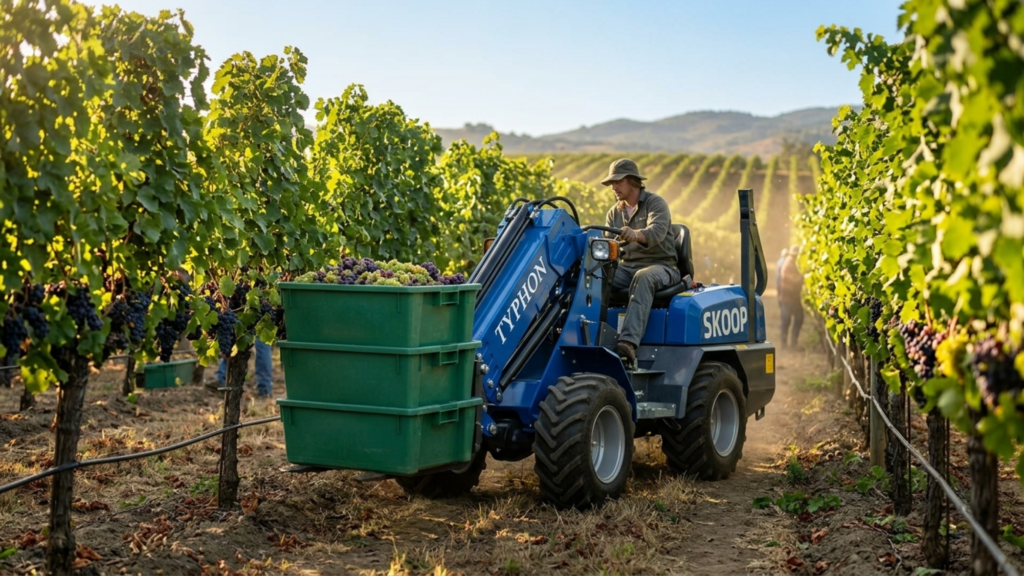
Orchards and vineyards present a particular set of challenges, and compact wheel loaders are especially valuable in these settings. The narrow rows between trees and vines demand a machine that is compact, agile, and precise, and a compact wheel loader fits these requirements far better than larger equipment ever could. Operators use these machines to transport harvested fruit, move bins and crates, haul pruning debris, and carry supplies up and down the rows without damaging the plants that represent years of investment.
During harvest, the loader’s efficiency in moving full bins from the rows to collection points speeds up the entire operation, which matters enormously when fruit must be gathered within a narrow window of ripeness. Outside of harvest, the machine handles the ongoing maintenance tasks that orchards and vineyards require, from moving mulch and compost to transporting equipment and clearing trimmings. Its tight turning radius and careful handling let operators work confidently in spaces where every inch counts, protecting both the crop and the machine while keeping the work moving.
Supporting Livestock Operations
Livestock operations rely on compact wheel loaders for a remarkably broad range of daily tasks that go well beyond feeding and manure handling. Bedding management is a constant need, and a loader moves straw, sawdust, and other bedding materials into stalls and pens quickly, keeping animals comfortable and healthy. The machine also handles the heavy lifting involved in maintaining fences and gates, transporting water tanks and equipment, and moving the countless supplies that a livestock operation consumes.
The maneuverability of a compact wheel loader is a real advantage around animals, where calm, controlled movement matters for both safety and the well-being of the herd. Operators can position the machine precisely in close quarters without the abrupt motions or excessive size that might stress livestock. Because the same machine handles so many different jobs around the operation, it becomes an indispensable part of the daily routine, ready to take on whatever the day demands. That dependability is exactly what livestock producers need from their farming equipment, since the animals require care every day regardless of the weather or the calendar.
Seasonal and Year-Round Versatility
One of the strongest arguments for the compact wheel loader is its usefulness across every season. Farming work changes dramatically through the year, and a machine that adapts to those shifting demands earns its place in the equipment shed many times over. In spring, the loader supports planting preparation, moves seed and fertilizer, and helps with the site work that the growing season requires. Through summer, it handles hay, transports materials, and keeps daily operations running smoothly during the busiest stretch of the year.
Autumn brings harvest, and the loader proves its worth moving crops, loading trucks, and clearing fields for the next phase. When winter arrives, the same machine takes on cold-weather tasks with ease. Fitted with a snow bucket or blade, it clears snow from driveways, yards, and access roads, keeping the farm functional and safe when storms hit. Throughout the colder months, it continues moving feed and bedding to livestock that depend on consistent care no matter the conditions. This year-round versatility means the machine is rarely idle, and that steady utilization is what makes a compact wheel loader such a sound investment for an agricultural operation. A tool that works in every season delivers a return that a single-purpose machine simply cannot match.
Choosing the Right Compact Wheel Loader for Your Farm
Selecting the right machine begins with an honest look at the work your operation actually performs. Start by considering the heaviest and most frequent tasks you expect the loader to handle, since lift capacity and breakout force determine whether a machine can manage your bales, your feed volumes, and your material handling needs with room to spare. A loader that is undersized for your routine work will struggle and wear out faster, while one matched correctly to your demands will serve reliably for years.
Next, think carefully about the attachments your operation requires, because the true value of a compact wheel loader lies in its versatility. A quick-attach coupler that lets you switch between buckets, pallet forks, bale spears, grapples, and seasonal tools quickly and easily transforms a single machine into a complete material handling solution. Consider the spaces where the machine will work as well, confirming that its size and turning radius suit your barns, gates, and rows. Finally, weigh the terrain and conditions across your property, and choose tires and a configuration suited to the mud, gravel, slopes, and surfaces you encounter most. Working with a knowledgeable equipment dealer who understands agricultural applications helps ensure you select a machine and attachment package matched precisely to your operation, so your investment pays back in productivity, reliability, and years of dependable service.
Conclusion
The agricultural uses for compact wheel loaders stretch across nearly every part of a working farm, from moving hay bales and handling feed to managing manure, loading materials, clearing land, tending orchards and vineyards, supporting livestock, and tackling the seasonal tasks that fill the calendar year-round. What makes these machines so valuable is the combination of attachment versatility, maneuverability in tight spaces, and the ability to handle the varied terrain that farms present every day. One well-chosen loader does the work of several specialized machines, saving labor, reducing strain on your crew, and keeping your operation moving through every season.
For farmers, agricultural business owners, and equipment buyers, the path forward is straightforward. Assess the tasks your operation depends on, define the lift capacity and attachments you need, consider the spaces and surfaces where the machine will work, and consult a trusted equipment partner who understands farm applications. Choose with that care, and a compact wheel loader becomes one of the most dependable and hardworking investments on your property, ready to deliver real value shift after shift, season after season.