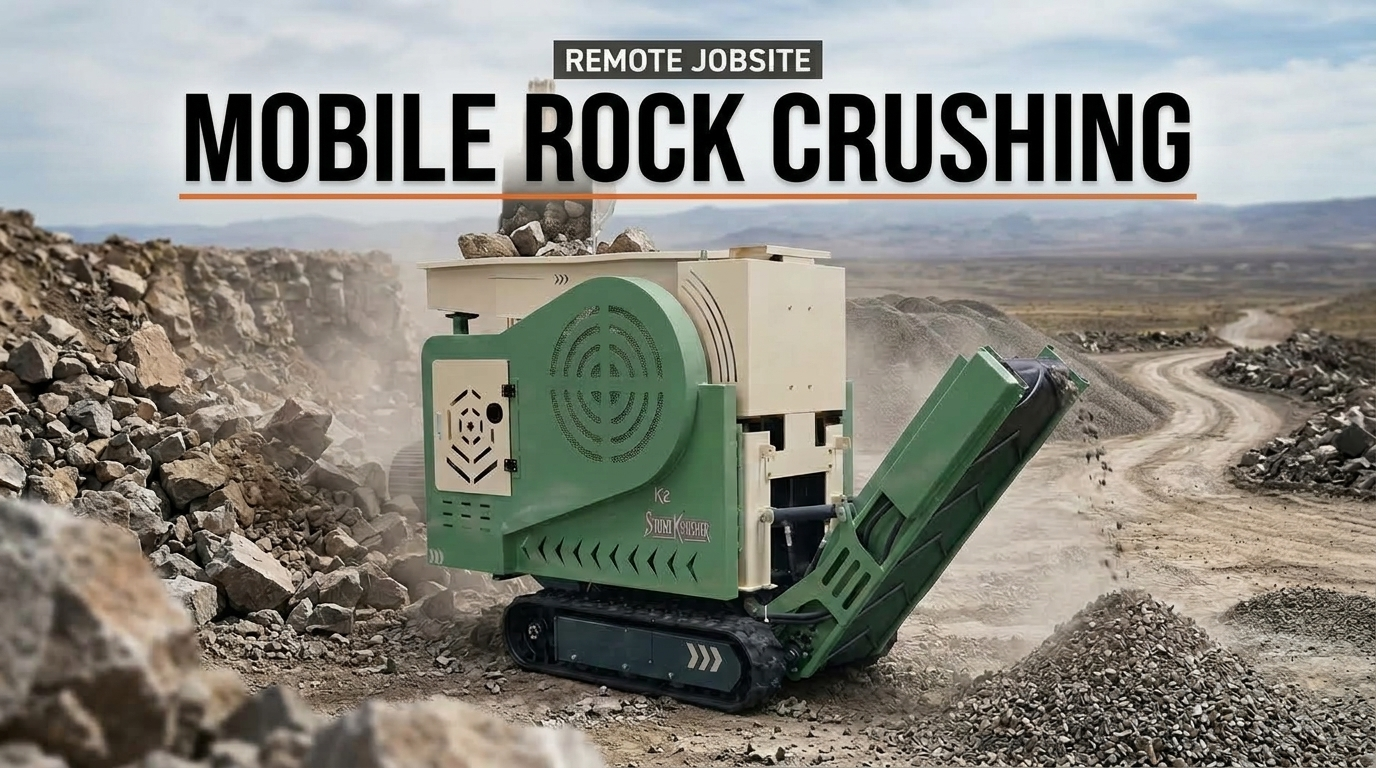
Remote jobsites present a challenge that catches many contractors off guard: the material is right there, but getting it processed is anything but simple. Long distances to crushing facilities, limited road access, and no permanent infrastructure can turn a straightforward project into a logistical headache. Mobile crushing equipment offers a practical answer, bringing the crushing operation directly to where the work happens. This guide explains how mobile crushing equipment supports remote jobsites across five key areas. You will learn how on-site processing works, how it cuts down on hauling, why easy transport between work areas matters, how these machines reduce dependence on fixed infrastructure, and how they deliver flexible production as conditions change. By the end, you will understand why mobile crushers have become a dependable choice for contractors working far from established facilities. On-Site Material Processing Mobile crushing equipment allows materials such as rock, concrete, and demolition debris to be processed directly at the jobsite, and this capability changes how remote projects unfold. Rather than moving raw material to a separate crushing facility, the machine comes to the material. This on-site approach means excavated rock, broken concrete, and demolition rubble can be reduced to usable aggregate right where it is produced, turning what would otherwise be waste into product ready for the next phase of construction. The value of processing material on-site becomes clear the moment you consider the alternative. Transporting raw material to an off-site facility involves loading, hauling, processing, and often hauling the finished product back again. Each step adds time, cost, and coordination. A mobile crusher removes those steps by handling the work in place, so the material never has to leave the site to become useful. On-site processing suits a wide range of common materials and tasks: This direct approach keeps the operation self-contained and productive. When a crew can excavate, crush, and use material without waiting on outside facilities, the entire project moves at a steadier pace. For remote sites where every trip off-site is costly and time-consuming, the ability to process material where it sits is one of the clearest advantages mobile crushing equipment brings to the work. Reduced Material Hauling By processing material closer to where it is excavated, mobile crushers can significantly reduce the number of hauling trips a project requires. This benefit follows naturally from on-site processing, but it deserves attention on its own because hauling is often one of the largest hidden costs on a remote job. Every load of raw material moved to an off-site facility, and every load of finished aggregate brought back, means fuel, driver hours, and vehicle wear. When a mobile crusher handles the work on-site, many of those trips disappear. The impact is greatest on remote sites, where the challenges of hauling multiply. Limited road access can make it difficult to move heavy loads of raw material in and out, and long distances to the nearest processing facility can turn each round trip into hours of travel. In these conditions, reducing the number of hauling trips does more than save money. It simplifies the entire logistics picture, easing pressure on narrow access roads and reducing the coordination needed to keep trucks moving. Consider a site located far from the nearest crushing plant. Without a mobile crusher, the crew would haul raw material out, wait for processing, and haul aggregate back, repeating the cycle throughout the project. With a mobile crusher on-site, the material is processed in place and used immediately, cutting a long, repetitive haul down to little or nothing. Fewer trucks on the road also means less congestion and lower risk of delays caused by weather or road conditions. For contractors managing remote projects, this reduction in hauling is a dependable way to keep logistics manageable and the project on schedule. Easy Transport Between Work Areas Compact mobile crushers can be moved from one working area to another as the project progresses, and this mobility is one of their defining strengths on remote and evolving jobsites. A project rarely stays in one spot. Excavation moves along a route, demolition shifts from one structure to the next, and material sources change as the work advances. A crusher that can travel with the work keeps processing close to the material no matter where the active zone happens to be. This flexibility proves particularly useful when material sources and processing locations change throughout the job. On a long linear project, such as a road or pipeline, the point where material is excavated shifts continuously. Rather than hauling material back to a fixed crushing location, the crew can reposition the crusher to stay near the current work front. This keeps hauling distances short even as the project stretches across a large area, preserving the efficiency that makes on-site processing worthwhile in the first place. Moving a mobile crusher between work areas is designed to be straightforward. Tracked and wheeled configurations allow the machine to travel across a site or be transported between locations with minimal setup, so relocating it does not become a project of its own. This means a crew can respond quickly as conditions change, positioning the crusher where it will do the most good at each stage. The result is a processing operation that adapts to the project rather than forcing the project to adapt to it. For remote sites where the work naturally spreads out and shifts over time, the ability to relocate a compact crusher easily keeps material processing efficient from the first phase to the last. Less Dependence on Fixed Infrastructure Remote jobsites often have limited access to permanent crushing plants, storage areas, or processing facilities, and this is where mobile crushing equipment truly earns its place. A fixed plant assumes reliable roads, nearby facilities, and established infrastructure, none of which can be taken for granted in remote locations. Mobile equipment removes that assumption by providing a self-contained option for handling material closer to the source, giving contractors a way to work productively where permanent infrastructure simply does not exist.