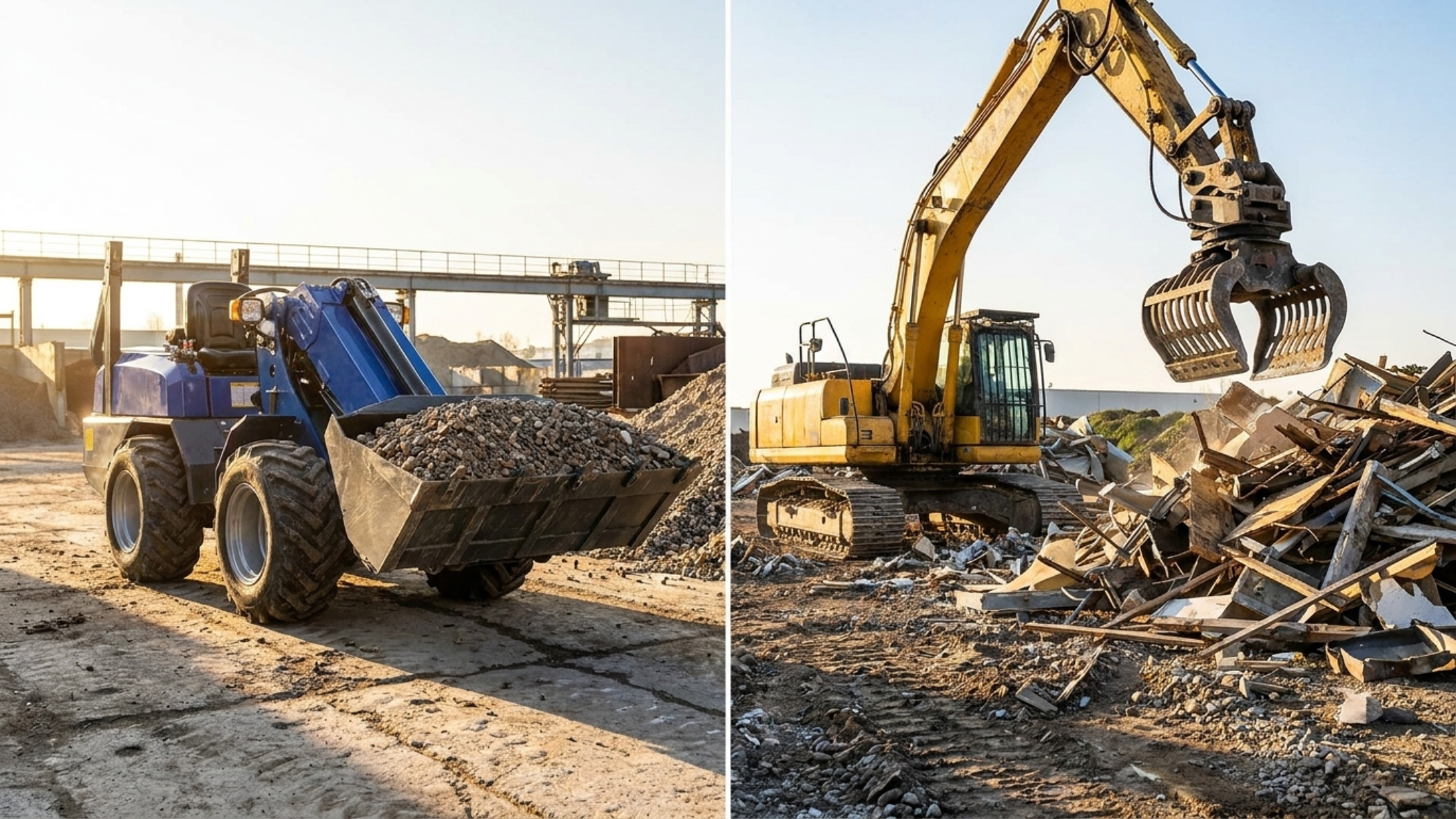
Picture a sprawling recycling facility, concrete plant, or aggregate yard at peak operation. Semis are backing up in a continuous line, production hoppers are running empty, and thousands of tons of loose material need to be sorted, stacked, and loaded before the closing whistle. In the middle of this high-stakes choreography sits the ultimate equipment dilemma: do you assign a wheel loader or an excavator to keep the operation running smoothly? What fleet managers and project supervisors frequently get wrong is looking strictly at bucket capacity or machine horsepower when weighing a wheel loader vs an excavator for material handling. They overlook how the physical layout of the site, travel distances, and the angle of approach radically alter the efficiency of each machine. Choosing the wrong piece of equipment for your yard layout is a guaranteed way to drive up cycle times, accelerate tire or track wear, and burn through thousands of dollars of extra fuel. Understanding the operational differences between these two heavy-duty workhorses goes far beyond simple digging capability. Making the right choice directly optimizes your site logistics, controls daily machine depreciation, lowers your cost-per-ton metrics, and ensures you hit your daily production targets without bottlenecking your entire fleet. The Mobility Constraint of Tracked Machinery You are managing an extensive aggregate yard where the sand, gravel, and crushed stone piles are spread hundreds of feet apart across a rough gravel lot. A line of commercial dump trucks is waiting at the main gate, and they need to be loaded from different piles as quickly as possible. If your primary machine for this task is a standard crawler excavator, your operation will face an immediate, frustrating limitation. Excavators are fundamentally designed to sit in one fixed spot, dig, pivot, and dump. When an excavator has to constantly travel back and forth across a massive yard to reach different stockpiles, its productivity plummets. The steel tracks or rubber pads of an excavator move slowly, typically topping out at less than 4 miles per hour. Moving long distances causes massive frictional wear on the undercarriage components, leading to thousands of dollars in premature track maintenance. In real-world yard conditions, forcing an excavator to act as a mobile transporter results in slow cycle times, high fuel burn as the engine works to move the heavy undercarriage, and an increasingly frustrated line of truck drivers waiting at the scale. The impact is felt everywhere—from reduced yard safety due to blind spots during tracking to a drop in overall daily volume. To overcome this mobility hurdle, you have to shift your focus to a platform built explicitly for high-speed ground transport. High-Speed Bulk Transports on Wheel Loader When your material handling tasks require rapid movement across substantial distances, the wheel loader completely transforms your workflow. Instead of crawling on tracks, a wheel loader rides on massive, heavy-duty pneumatic tires and utilizes an articulated steering system. This allows the machine to easily reach travel speeds of 12 to 25 miles per hour across a busy job site. The loader operates via a dynamic “load-and-carry” cycle: it drives forward into a stockpile with immense momentum, fills its high-capacity bucket, and immediately transports that material hundreds of feet away to a hopper or an awaiting haul truck. In a real-world yard scenario—such as a bulk composting facility or a highway construction staging area—a single wheel loader can manage multiple stockpiles simultaneously. It can scoop three tons of organic mulch, race across the yard to fill a customer’s truck, and pivot back to the main pile before an excavator could have even tracked halfway across the lot. The impact on your workflow is clear: significantly faster cycle times, drastically reduced undercarriage maintenance, and a highly agile operation that can pivot to different tasks instantly. However, high-speed mobility is no longer the winning factor when your material handling must happen within a highly restricted footprint or from a stationary, elevated position. The Power of Stationary Precision The load-and-carry efficiency of a wheel loader breaks down entirely when the jobsite dynamics change from wide-open horizontal movement to tight, vertical, or deep-level material extraction. Imagine you are running a high-volume demolition recycling yard or a deep sand pit where material must be extracted from a deep trench or reached over a high structural wall. A wheel loader cannot dig below its own wheels effectively, and it requires a wide, clear path to approach a pile, turn around, and dump. If the work area is cramped, muddy, or requires reaching over obstacles, a wheel loader will spin its tires, lose traction, and struggle to fill its bucket safely. This is the exact environment where an excavator becomes the superior choice for material handling. By utilizing its 360-degree rotating cab, boom, and stick assembly, an excavator can remain completely stationary while reaching down into pits, over barriers, or high up into industrial shredders. In real-world conditions, an operator can position an excavator on a stable bench overlooking a massive pile of concrete debris. The machine can continuously sort, lift, and load material into a crusher without moving its tracks an inch. This eliminates tire slippage, keeps the machine out of dangerous muddy, stable zones, and provides unparalleled precision when separating materials. As your daily intake of material scales up to maximum capacity, the differences between these two approaches dictate your entire production volume. Scaling Up to High-Volume Production Loading When your facility shifts from intermittent material handling to continuous, high-volume production loading—where a single hour of downtime can cost thousands of dollars—the scale of your machinery must step up accordingly. In ultra-high-volume environments like large quarries or massive rail yards, the choice between a wheel loader vs. an excavator for material handling hinges entirely on the site layout and the haul fleet setup. If you are loading a continuous line of rigid-frame quarry trucks from a single, static rock face, a large production-class excavator is often preferred. The excavator sits high on the muck pile, reaches down to scoop blasted rock, and