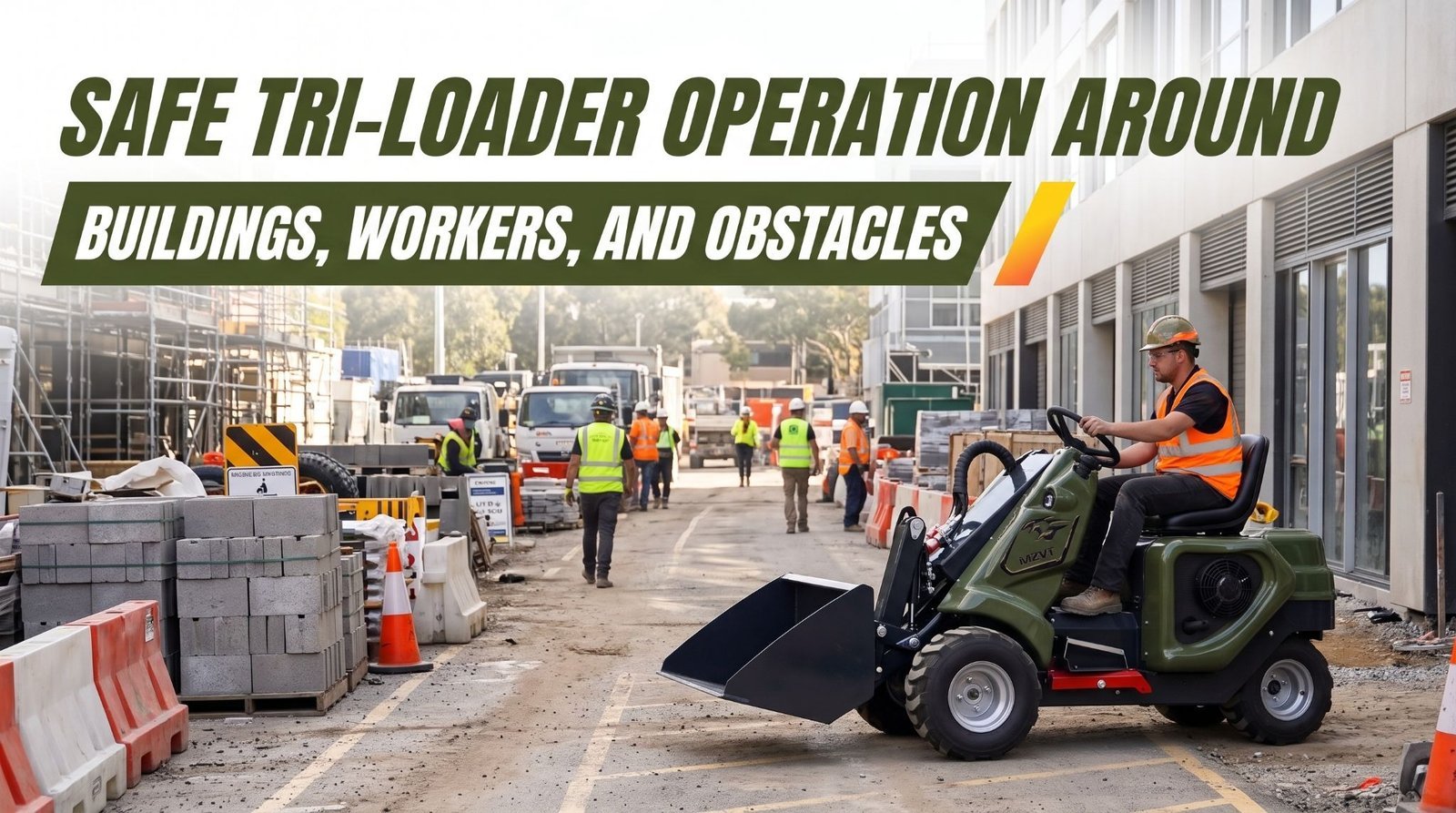
Tri-loaders often work where space is tight and activity is constant. On a residential build, a renovation project, or a commercial site, the machine may load spoil beside a foundation, carry pallets of blocks along a narrow path, or move gravel between parked vehicles and stacked materials. In each case, buildings, workers, vehicles, and stored materials share limited space, and the loader has to move through it all. Compact size and nimble handling are what make tri-loaders valuable in these settings. They are also what bring the machine into close range of the people and structures around it. A loaded bucket swinging near a wall, a turn made without checking behind the machine, or a worker who steps into the travel path at the wrong moment can turn a routine task into a serious incident. Collisions with buildings cause costly damage and delays. Contact with a person can cause life-changing injuries. Safe operation in these conditions does not happen by chance. It comes from a clear travel plan, controlled attachment movements, good visibility, and steady coordination with everyone nearby. When those elements are in place, the tri-loader works efficiently and predictably, and crews can trust the machine operating beside them. Visibility Around Structures An operator can only avoid what they can see. Around buildings and stored materials, visibility from the seat becomes limited quickly, and blind spots grow larger than many crews realize. Check the full machine path before moving. Look in every direction the machine will travel, including behind it before reversing. Use mirrors and cameras where fitted, and keep them clean and correctly adjusted from the operating position. Sound the horn before moving off and at blind corners and doorways where site rules call for it. Move slowly wherever visibility is limited. Lower speed gives the operator more time to react and gives workers more time to notice the machine. Approach corners wide where space allows, and stop before entering an area you cannot see into clearly. The spotter must remain in a safe position where the operator can see and communicate with them. If the spotter moves out of view, gives an unclear signal, or is distracted, the operator stops all movement until communication is restored. Lighting matters as well. Early mornings, evenings, overcast days, and work inside partially enclosed structures reduce contrast and hide hazards. Use work lights where fitted, and add temporary lighting to dim areas along the route. Key takeaway: Buildings, walls, stacked materials, and attachments create blind spots, so check the full machine path before every movement, use mirrors and cameras where fitted, and use a trained spotter who stays safe, visible, and in clear communication with the operator. Managing Workers and Pedestrians On a busy jobsite, the tri-loader shares space with laborers, tradespeople, supervisors, delivery drivers, and sometimes members of the public. Every person on foot near a moving machine is at risk, and that risk is greatest when the operator and the worker each assume the other has seen them. Keep people outside the loader’s operating and turning area. Establish an exclusion zone around the machine that covers: Mark the zone with cones or barriers where practical, and brief everyone on site before work begins. Workers should understand where the loader will operate, which areas are off limits while it is moving, and how to approach the machine safely when they need to. Stop immediately if someone enters the machine’s path or the operator loses sight of the spotter. Lower the load, hold the machine stationary, and resume only after the area is clear and communication is restored. A few seconds of waiting is always better than continuing with uncertainty. Only the operator should ride on the machine. Never carry passengers on the loader, in the bucket, or on any attachment, and never use the bucket to lift people. Start-of-shift briefings help keep everyone aligned. Cover the day’s travel routes, unloading areas, exclusion zones, and any changes to site layout. Encourage workers to report near misses and congestion points so supervisors can address them before they lead to incidents. Key takeaway: Keep people outside the loader’s operating and turning area, set clear communication rules before anyone approaches the machine, and stop immediately whenever someone enters the path or the operator loses sight of the spotter. Load Height and Stability How a tri-loader carries its load has a direct effect on both visibility and stability. A load carried too high blocks the operator’s view and raises the machine’s center of gravity. A load carried during sharp turns or sudden stops can shift and destabilize the machine without warning. Carry material low enough to maintain visibility and stability during travel. Keep the bucket or attachment as low as practical while maintaining ground clearance, with the bucket rolled back to hold the load securely. A low load keeps the center of gravity down, improves the operator’s forward view, and reduces the chance of material spilling onto the route. Raise the attachment only when positioned for the intended placement or unloading task. Lifting the load while traveling increases sensitivity to slopes, bumps, and turns, and it blocks the operator’s view of the path ahead. Approach the unloading point slowly and squarely, stop, and then raise the load. Always wear the seat belt and keep the operator restraint system in place. These systems keep the operator inside the protective structure if the machine tips or stops suddenly. Key takeaway: Carry loads low and rolled back during travel, raise the attachment only when positioned to place or unload, stay within rated capacity, and avoid sudden turns or hard braking with a load. Work Area and Travel Route Safe tri-loader operation begins before the engine starts. A clear understanding of the work area, and a planned route through it, prevents most of the close calls that happen on busy sites. Operators who know exactly where they are going, and what lies along the way, can focus on controlling the machine rather than reacting to surprises. Check each