The Benefits of Switching to an Electric Warehouse Forklift
A warehouse manager walks the floor mid-morning and notices the same three problems he’s fought for years: a haze of exhaust near the far dock, a fuel bill that keeps climbing, and two workers shouting to be heard over a running engine. His propane forklifts do the job, but they drag a stack of costs and headaches that never quite disappear. When he finally trials an electric warehouse forklift on the busiest picking line, the difference lands fast. No fumes, no engine roar, and a charge that costs a fraction of a propane tank refill. Within a few weeks, the rest of the fleet gets earmarked for replacement, because the case for switching has made itself.
Warehouses across virtually every sector are making the same move, and the reasons are practical rather than trendy. An electric warehouse forklift runs cleaner, costs less to operate day to day, works more quietly, needs lighter maintenance, and now matches combustion machines on the indoor performance that once gave operators pause. The upfront investment is real, but so is the return, and for most steady indoor operations, the math comes out decisively in the electric machine’s favor over time. This post breaks down each of the core benefits in plain terms so you can weigh whether the switch makes sense for your operation. Here’s what you actually gain when you trade a combustion machine for an electric one.
Zero Emissions and Cleaner Indoor Air
Air quality is where the switch shows its value first, and the change is immediate. An electric warehouse forklift produces zero exhaust at the point of use, which means no fumes accumulate in an enclosed building through a full shift. Combustion machines, by contrast, push carbon monoxide and other exhaust gases into the air your crew breathes every hour, and in an enclosed space that demands constant ventilation, air monitoring, and careful management just to stay within safe limits.
Cleaner air protects your people in ways that add up over a career. Operators and floor workers who aren’t breathing exhaust all day show up sharper, stay healthier, and log fewer sick days, which keeps your operation running at full strength rather than short a person at the wrong moment. Beyond the crew, your product benefits too. Warehouses handling food, pharmaceuticals, electronics, or any goods sensitive to air contamination lean toward electric for exactly this reason, since a machine that runs clean removes a hazard entirely rather than managing it with ventilation patches.
Compliance becomes simpler as well. Meeting indoor air-quality requirements matters with any lift truck, and an electric unit makes that job far easier to sustain day after day without constant monitoring adjustments. Reviewing your building’s ventilation setup against your current fleet often reveals just how much work you’re doing to compensate for combustion fumes. Remove the source and most of that management work disappears with it.
Lower Operating Costs Over Time
Cost is the number most managers track closest, and this is where an electric forklift earns back its higher sticker price. Charging a battery runs far cheaper than buying propane or diesel for the equivalent work, and electricity prices tend to stay far steadier than fuel prices, which swing with the market and can spike unexpectedly. Over a few years of steady indoor use, those lower energy costs often close the upfront purchase gap and then keep saving month after month.
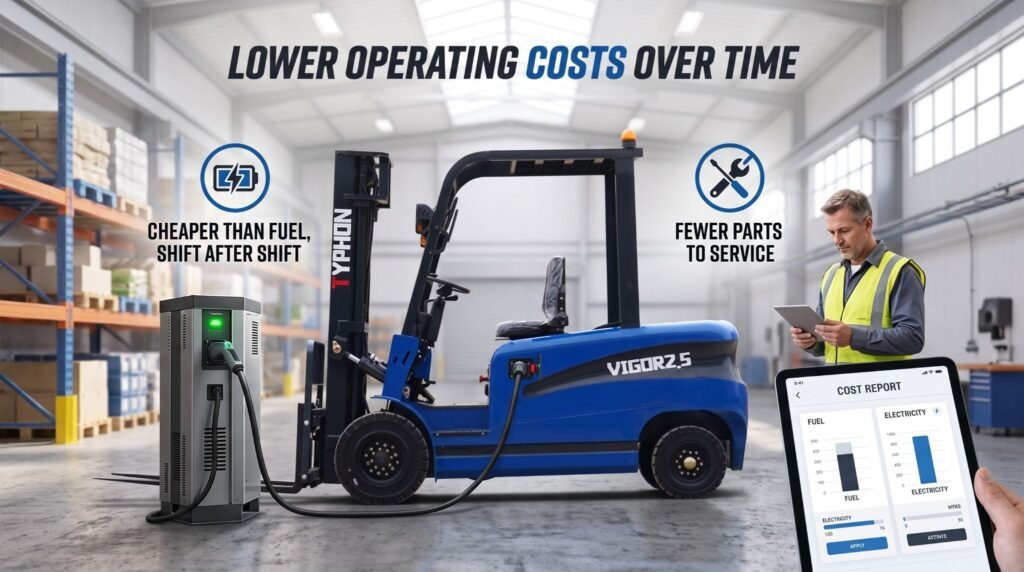
Fuel isn’t the only line item that drops. Fewer moving parts mean fewer things to service and replace, so savings stack on both the energy and the maintenance side of the ledger. Consider a fleet running two shifts, five days a week: the difference in fuel cost alone between propane and electricity adds up to a significant sum over a year, and that’s before you factor in the reduced parts and labor spend. Whether the total math favors electric comes down to how many hours you actually run the machine, so running the numbers honestly against your real workload keeps the comparison grounded.
For most single-shift or predictable indoor operations, the long-term cost picture tilts electric clearly. The savings aren’t front-loaded, they accumulate, which is exactly why operations that commit to electric early tend to expand the fleet rather than go back. Every month the machine runs, the return on that initial investment gets a little stronger.
Quieter Operation Across Every Shift
Noise wears on a crew in ways that are easy to overlook until you actually remove it. Combustion engines run loud, and a busy warehouse full of propane or diesel forklifts turns a full shift into a shouting match that strains communication, damages hearing over time, and grinds operators down by afternoon. An electric warehouse forklift runs quietly, which changes the whole feel of the floor almost immediately from the first day it rolls out.
Quieter operation isn’t just a comfort perk, it’s a measurable safety and productivity gain. When operators can clearly hear spotters, backup alarms, paging systems, and each other, coordination sharpens and reaction times improve, which means fewer close calls and fewer mistakes. That clearer communication matters most during the busiest parts of the shift, exactly when noise from combustion machines peaks and masks the signals a crew depends on.
Reduced noise also cuts operator fatigue in ways that compound through the day. The person in the seat on a quiet electric machine arrives at hour seven, sharper and more accurate than the operator who spent the same shift fighting engine noise. For operations running multiple machines in the same building, that drop in ambient noise adds up across every shift, every week, and shows in both productivity numbers and operator retention over time.
Reduced Maintenance Demands
Upkeep looks completely different once you go electric, and that difference pays off in both money and uptime. A combustion forklift carries all the service an engine requires: oil changes on a regular schedule, filters for fuel and air, belts, spark plugs or injectors depending on the fuel type, coolant service, and exhaust components that wear and corrode. Each of those is a scheduled cost and a potential source of unplanned downtime. Strip the engine out of the equation and most of that maintenance disappears with it.
An electric machine has far fewer moving parts, no engine oil, no fuel system, and no exhaust components to inspect or replace. Day-to-day upkeep is lighter and more predictable, which means fewer surprise repair bills and a machine that’s easier to keep on a firm maintenance schedule. The battery does need proper attention: correct charging habits, watering on flooded lead-acid types, and eventual replacement when it reaches the end of its cycle life. Those needs are real, but they’re manageable and far less demanding than engine service.
Staying on a steady maintenance schedule protects uptime far more than most managers expect. Checking service intervals against the manufacturer’s documentation keeps the battery and drivetrain in top shape, and a machine that’s well maintained earns back its cost by staying on the floor rather than spending days in the shop. Less time in the shop means more hours moving pallets, and that reliability is a genuine part of the electric forklift’s value proposition.
Indoor Performance That Matches the Job
Enclosed space is exactly where an electric forklift belongs, and modern machines have closed whatever performance gap once gave operators pause. Smooth, responsive acceleration and precise control give many operators a machine that’s easier to handle in tight aisles than a jerkier combustion unit, and that precision matters when you’re threading between shelving, placing pallets on high racks, or working a narrow picking lane where a careless move costs time or damages product.
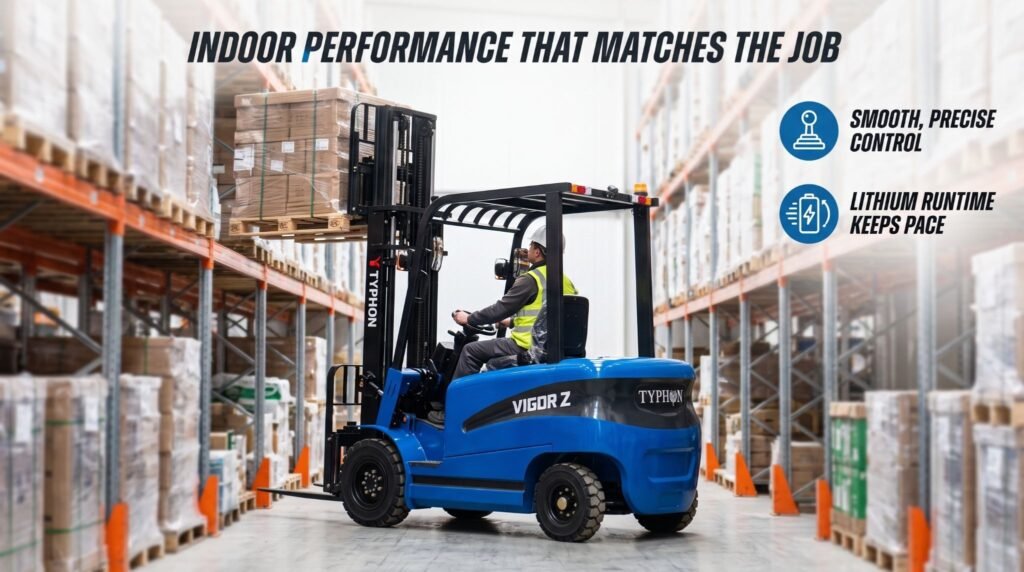
The performance case has also strengthened on the runtime side. Lithium-ion batteries and smart charging systems have expanded the range of operations where an electric machine keeps up without interruption. Fast-charge options can top up a battery during a lunch break, and battery-swap setups let a machine run back-to-back shifts without waiting. For most single-shift and predictable double-shift operations, runtime is no longer the limiting factor it once was.
The one honest limit shows up under very heavy, continuous demand where back-to-back shifts run without natural pauses. For those operations, battery planning and infrastructure become part of the decision. But for the broad majority of warehouse environments, clean floors, controlled temperatures, and structured shift patterns all play to the electric machine’s strengths. Match the runtime and capacity to your real hours and load weights, and an electric warehouse forklift handles the bulk of indoor work without missing a beat.
The Long-Term Case for Switching
Every benefit above compounds over time, and that compounding is what makes the switch compelling rather than merely interesting. An operation that switches to electric saves on fuel and maintenance each month, runs a cleaner and quieter floor each shift, and reduces its exposure to the regulatory and health risks that come with combustion exhaust indoors. Those gains don’t peak and level off, they keep accumulating as long as the fleet runs.
The wider industry is moving in the same direction, which matters for support and resale. Growing adoption has brought more model choices, stronger dealer networks, better parts availability, and steady improvements in battery technology, so the electric machines available today are meaningfully better than those of even a few years ago. Stronger resale value follows wider adoption, so the fleet you buy now holds its worth better on the used market than an equivalent combustion machine.
For a manager planning fleet decisions over three to five years, aligning with where the industry is clearly heading protects the operation from equipment that’s slowly aging out of relevance. The switch to electric isn’t a bet on a new technology, it’s a move toward what has already become the standard for indoor material handling.
Conclusion
Switching to an electric warehouse forklift pays off across every area that shapes an indoor operation every day. Zero emissions protect your crew’s health and simplify air-quality compliance, while lower charging and maintenance costs steadily close the gap on the higher purchase price and then keep saving. Quieter shifts improve safety and reduce fatigue, fewer moving parts mean less downtime and more predictable upkeep, and smooth precise handling suits the tight aisles and controlled conditions of a modern warehouse. Rising industry adoption backs all of it with stronger support, better technology, and better resale value over time.
Weigh your run hours, load weights, shift structure, and building conditions against your current fleet honestly, and the case for going electric usually becomes clear. When you’re ready to put a dependable electric warehouse forklift to work, reach out to a trusted equipment specialist who can pair a reliable machine with the results your operation depends on.
Frequently Asked Questions
Why switch to an electric warehouse forklift?
It runs with zero emissions and far less noise indoors, costs less to charge and maintain than a combustion machine, and offers smooth, precise handling that suits tight aisles and controlled environments, so the switch improves air quality, operator safety, and long-term cost all at once.
Is an electric forklift cheaper to run than a propane or diesel one?
Usually, yes. Charging generally costs far less than buying propane or diesel for equivalent work, electricity prices stay steadier than fuel markets, and fewer moving parts mean lower maintenance costs, so for steady indoor use an electric machine often recoups its higher upfront price and keeps saving over time.
Can an electric forklift handle heavy warehouse work?
For most indoor operations, it performs on par with combustion machines, offering strong lift capacity and smooth, precise control. Very heavy, continuous multi-shift demand requires careful battery planning, but fast-charge options and battery-swap setups address that for operations that need uninterrupted runtime.