Wheel Loader vs Track Loader Comparison: Real-World Jobsite Logistics
You pull up to a newly cleared commercial subdivision site following three consecutive days of torrential summer rain. The engineered topsoil has transformed into a soup of deep clay mud, the structural building pads are surrounded by standing water, and a line of tri-axle dump trucks is idling at the main gate waiting to be loaded with structural base stone. In this exact moment, you have to assign your primary digging and material transport equipment. If you dispatch a machine that gets bogged down up to its axles, your entire crew stands around bleeding billable hours. Conversely, if you deploy an asset that moves too slowly across the wide site footprint, you create an expensive truck bottleneck at the gate.
What fleet managers and heavy equipment estimators frequently get wrong when conducting a wheel loader vs track loader comparison is focusing solely on engine horsepower ratings or standard bucket capacities. They mistakenly treat these two earthmovers as interchangeable loading tools. They overlook the immense impact that ground engagement systems—tires versus steel tracks—have on structural site layout, traction coefficients, operator cycle patterns, and daily operating costs. Forcing a heavy wheeled unit onto a slick, uncompacted slope results in endless tire spinning, ruined ground surfaces, and shredded rubber. On the flip side, forcing a tracked unit to execute long-distance load-and-carry runs across hard-baked soil rapidly burns up expensive undercarriage components and destroys fuel economy.
Gaining a practical, grounded understanding of this heavy machinery dynamic is crucial for running a streamlined earthmoving or recycling operation. Analyzing how each machine moves material through real-world conditions allows you to optimize site logistics, predict long-term undercarriage and tire depreciation, control daily fuel expenditures, and select the exact machine geometry required to keep your project tracking ahead of schedule and under budget.
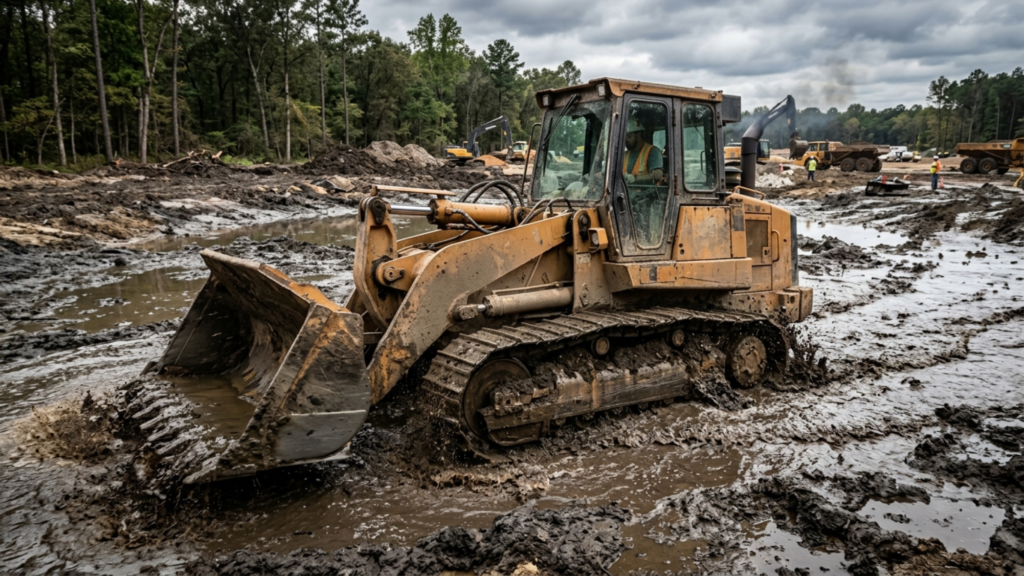
The Traction Breakdown on Unstable Ground
You are looking at a jobsite layout where your operators must clear a heavily wooded hillside, dig out raw, rocky soil, and cut a new access road across an uncompacted, muddy basin. If you try to attack this raw terrain with a conventional, articulated wheel loader, your operations will encounter steep physical and structural limitations.
The core issue stems from high ground-bearing pressure concentrated on four individual points of rubber contact. When a heavy wheel loader hits deep mud or steep, slick clay hills, the immense torque delivered to the wheels overcomes the limited traction of the tire treads. The tires spin aggressively, digging the machine deeper into the ruts, tearing up the grade, and creating a massive safety hazard.
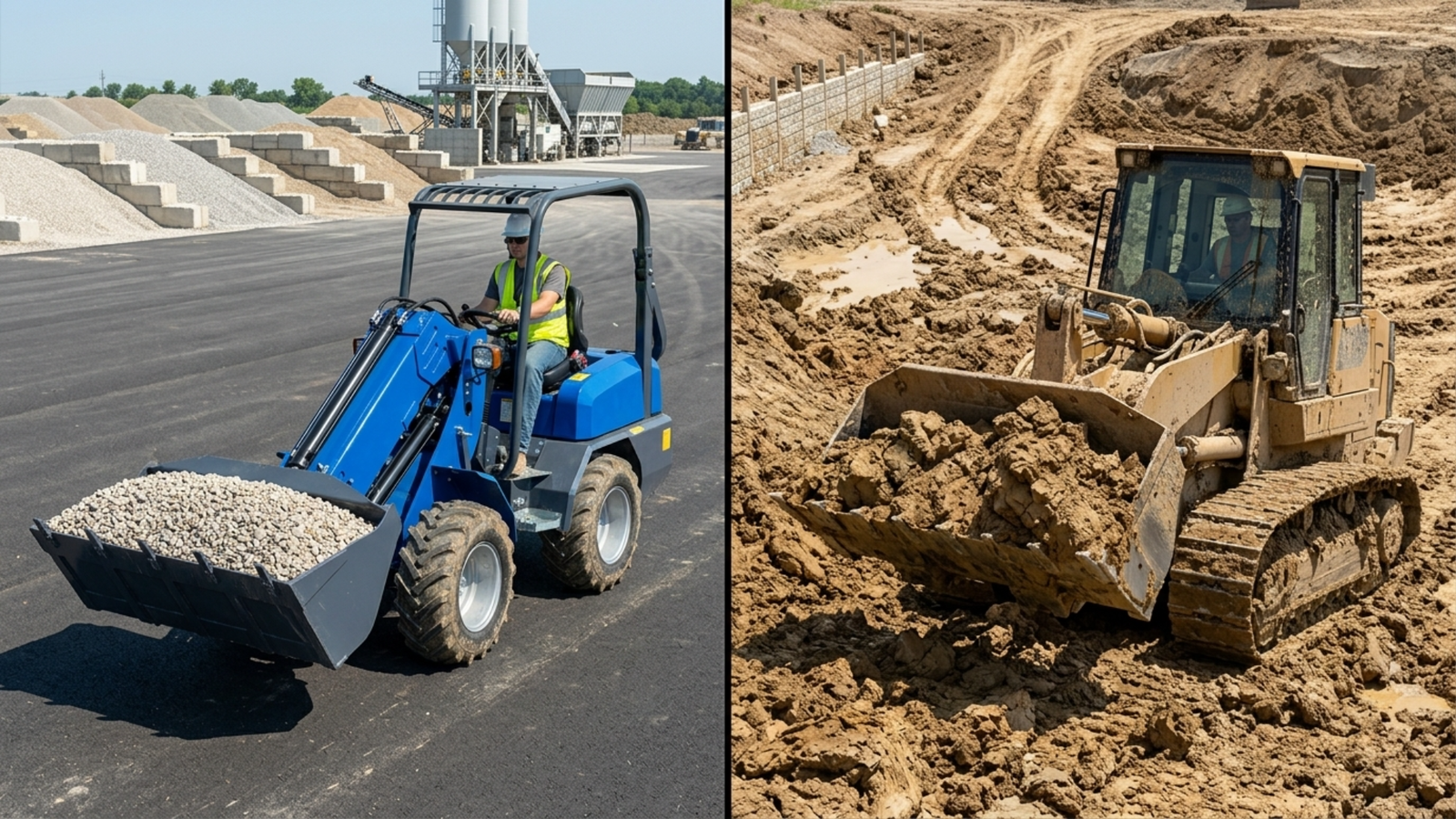
This is the exact operating condition where a track loader completely dominates the workflow. Utilizing two continuous, heavy steel or rubber tracks, a track loader distributes its massive operating weight across an incredibly broad surface footprint. This dramatically lowers its ground-bearing pressure, allowing the machine to literally float over deep mud, loose sand, and unstable slopes where a wheeled vehicle would instantly sink.
In real-world clearing conditions, the track loader acts as a stable, unstoppable tank. Its steel tracks bite into the earth, providing maximum drawbar pull to rip out stubborn tree stumps, dig directly into hard-packed hillsides from a standstill, and maintain a perfectly level grade without slipping. The impact on your workflow is clear: continuous production regardless of weather, zero downtime spent towing stuck equipment, and an operator who can confidently clear raw ground.
However, this raw digging power and low-ground-pressure flotation come with an operational speed limit that breaks down when site distances expand.
The Speed and Mobility Constraint of Tracks
The incredible traction and stable digging platform of the track loader become a massive operational bottleneck when your job site transitions from tight, raw excavation zones to expansive, wide-open aggregate yards or multi-acre commercial developments.
Imagine your project requires taking material from a centralized stockpile and transporting it several hundred feet across a massive site to backfill a foundation wall or load a high-sided processing hopper. If an operator attempts this load-and-carry cycle using a track loader, productivity drops significantly. Steel and rubber tracks are fundamentally designed for low-speed, high-torque applications, typically topping out at maximum travel speeds of only 6 to 9 miles per hour. Forcing a tracked machine to travel long linear distances back and forth across a hard, baked-earth lot introduces severe mechanical vibration and frictional heat.
This continuous traveling accelerates undercarriage wear exponentially. The pins, bushings, idlers, and rollers that make up a track system are highly sensitive to high-speed friction. Traveling miles per day in a track loader will quickly rack up thousands of dollars in premature undercarriage rebuild costs. Additionally, the constant tracking causes severe operator fatigue due to the rough ride over hard ground, while the high rolling resistance of the tracks forces the diesel engine to work harder, driving up daily fuel consumption.
To overcome this speed barrier and protect your operating margins on long-distance runs, your equipment framework must pivot to a highly mobile wheeled platform.
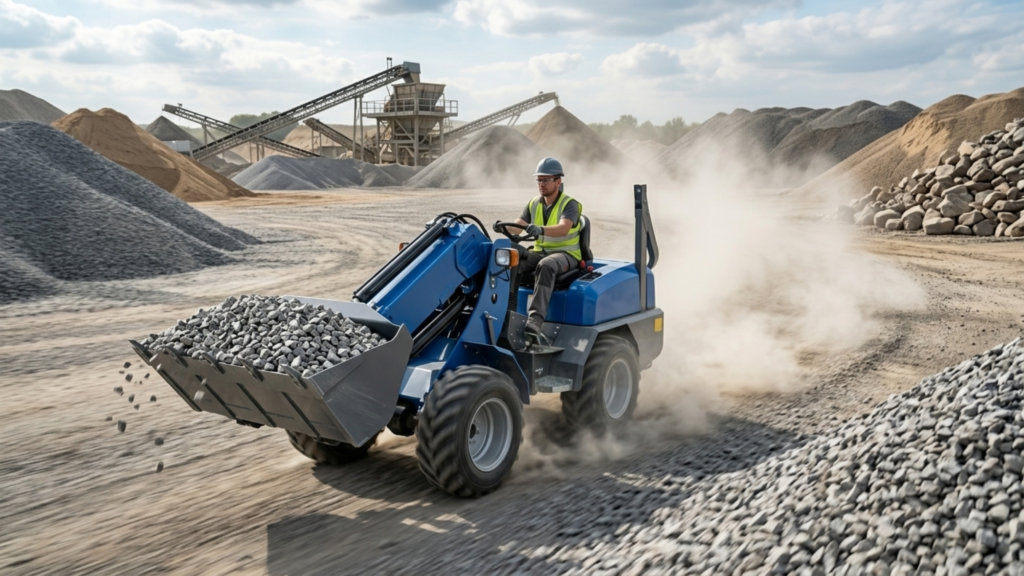
High-Speed Load-and-Carry on Tires
When your material handling and earthmoving tasks require fast, agile movement across large distances, the wheel loader completely redefines your jobsite efficiency.
By replacing heavy, high-maintenance tracks with four massive, pneumatic rubber tires and an articulated steering chassis, the wheel loader easily reaches travel speeds of 10 to 25 miles per hour across a busy workspace. This high-speed capability shifts the machine into a dynamic, highly productive transport asset. In a classic “load-and-carry” cycle, a wheel loader can drive hard into a gravel stockpile, fill its high-capacity bucket to the brim, pivot smoothly via its articulated joint, and race across the site to dump the material hundreds of feet away before a track loader could have even completed half the transit distance.
In real-world yard applications—such as a bulk aggregate facility, a commercial concrete plant, or a highway paving staging area—the wheel loader serves as a fast-moving bridge between stockpiles and haul vehicles. Its rubber tires glide smoothly over hard asphalt, packed concrete, and dry gravel roads without damaging the surface or creating excessive noise and vibration. The operational impact is a massive drop in cycle times, an influx of hauled tons per hour, and a dramatic reduction in fuel burn per ton of material moved.
However, this high-speed horizontal transit capability relies entirely on having a relatively firm, clear floor to operate on. If that floor becomes choked with sharp steel debris or transitions into high-capacity industrial processing, the choice between these two platforms shifts toward structural capacity and machine scale.
Scaling Up to High-Capacity Production Work
When your operations move past basic site prep and enter the realm of high-volume production loading—such as a deep quarry pit, a massive demolition recycling hub, or a continuous mining operation—the scale of your chosen machinery dictates your entire bottom line.
In these high-capacity environments, any comparison between a wheel loader vs a track loader must account for the physical size limitations engineered into the machines themselves. Track loaders are highly specialized tools, and manufacturers typically cap their sizes around the mid-range tier, rarely building them to match the gargantuan proportions of large production-class mining machinery. If your goal is to fill an 80-ton rigid-frame mining truck in three quick passes, you will not find a track loader large enough to physically reach over the sideboards or carry a massive 15-cubic-yard bucket.
This ultra-high-capacity loading space is the exclusive domain of the large wheel loader. These giant production machines are built with massive buckets and high-output hydraulic systems engineered to move mountains of heavy rock and blasted ore hour after hour.
The trade-offs at this production scale are intense and highly financial. Large wheel loaders require massive capital investments, and their specialized earthmover tires can cost upwards of $20,000 per tire. If your quarry floor is covered in sharp, unblasted granite fragments, those expensive tires can be cut and destroyed in a matter of weeks without the added expense of tire protection chains.
Understanding these extreme production dynamics reveals that sometimes, you need to step away from pure, raw loading capacity and look at a platform built for total job site multitasking.
The Crawler Loader as an All-in-One Multi-Tool
While the wheel loader wins on pure high-speed transport and maximum machine scale, the track loader (often referred to as a crawler loader) punches far above its weight class when a jobsite requires a single machine to perform multiple distinct heavy civil tasks.
Consider a mid-sized site contractor who can only afford to transport and operate one major piece of equipment on a remote residential clearing project. A wheel loader can scoop and carry material, but it cannot cut a clean, hard grade into a hillside, and it certainly cannot push bulk dirt like a bulldozer without spinning its tires and losing its line. A track loader, however, combines the distinct capabilities of three separate machines: the digging power of an excavator, the bulk pushing and grading ability of a crawler dozer, and the lifting and dumping capability of a loader.
Equipped with a heavy-duty, multi-purpose 4-in-1 bucket and a rear-mounted hydraulic ripper, a track loader can single-handedly clear thick brush, rip through frozen ground or soft rock, excavate a complete house foundation, rough-grade the driveway, and lift and load the stumps directly into a high-sided dump trailer. It trades away high transit speed to give the contractor absolute mechanical independence. In a real-world urban demolition use case, a crawler loader can crawl directly over piles of broken concrete, jagged rebar, and shattered glass that would instantaneously puncture and ruin the tires of a wheel loader, making it an incredibly resilient, flexible asset.
Decision-Making Guide: Choosing Your Fleet Asset
Bringing all of these mechanical, operational, and financial variables together into a clear fleet management strategy requires moving past basic machine preference and mapping your investment directly to your daily site conditions and contract structures.
Avoid the temptation to buy a machine based on rare, best-case scenarios or brand loyalty. Instead, utilize this comprehensive comparison framework to balance your daily jobsite constraints with the data points derived from a practical wheel loader vs track loader comparison:
Structural Performance Comparison
| Operational Metric | Wheel Loader | Track Loader (Crawler Loader) |
| Primary Drivetrain | 4-Wheel Drive on Pneumatic Tires | Continuous Steel or Heavy Rubber Tracks |
| Ground-Bearing Pressure | High (Concentrated at 4 tire patches) | Extremely Low (Distributed across track length) |
| Maximum Travel Speed | 10 to 25+ mph | 6 to 9 mph |
| Primary Cycle Task | Long-distance Load & Carry (>50 feet) | Static Excavating, Pushing, and Short Pivots |
| Mud & Slope Capability | Poor; prone to tire slippage and rutting | Excellent; high flotation and traction on slopes |
| Severe Debris Resistance | Vulnerable to costly tire cuts and punctures | Highly resilient against jagged rocks and rebar |
| Primary Component Wear | Friction on tire treads, brake pads, axles | High pin, bushing, idler, and track wear |
To execute your final machine purchase, lease, or long-term rental contract with absolute financial certainty, apply this two-step operational decision matrix:
Step 1: Analyze Your Primary Ground Conditions and Transit Distances
Look closely at the physical layout of your past five projects. If your operators are routinely moving materials across distances greater than 50 to 100 feet over relatively flat, firm, or paved surfaces (such as concrete recycling yards, aggregate staging lots, or master-planned commercial pads), the wheel loader is your clear economic winner. The massive time saved in transit speed directly lowers your labor costs, reduces fuel burn, and maximizes your daily truck throughput.
If your projects consistently place you in raw, unpaved environments dominated by thick mud, swampy topsoil, steep uncompacted slopes, or sharp, jagged demolition debris, choose the track loader. The machine’s low ground pressure ensures your operation stays up and running through harsh weather changes that would completely park a wheeled fleet.
Step 2: Evaluate Machine Versatility vs. Production Specialization
Calculate your true equipment utilization needs. If you require a high-speed, dedicated production loading asset to feed an insatiable crusher, screen plant, or continuous line of highway haul trucks from a clean stockpile, invest your capital in a dedicated wheel loader.
If you are a versatile, small-to-mid-sized contractor who needs a single machine to execute clearing, heavy excavation, bulk dozing, and precise finish grading on tight residential or wild woodland sites, bypass the wheel loader entirely. The immense multi-tool versatility of a track loader will easily replace two to three separate machine payments, keeping your asset overhead low, your transport logistics simple, and your bidding margins highly protected.
Conclusion
In the final analysis of a wheel loader vs track loader comparison, there is no single, universally superior machine. The ultimate value of your equipment asset is determined entirely by how it interfaces with the soil beneath its tracks or tires and the distances it must travel across your jobsite.
A wheel loader remains the undisputed champion of horizontal transit speed, high-volume yard loading, and clean asphalt mobility. A track loader stands as an elite powerhouse of raw traction, low-ground-pressure flotation, and multi-functional digging capabilities on unstable terrain. Prioritizing your specific site layouts, travel distances, and terrain challenges over basic machine size specs prevents costly tire destruction, premature track wear, and frustrating job site bottlenecks.
By analyzing your daily material flow through this practical operational lens today, you will secure the exact loader platform that slashes your cycle times, controls your maintenance overhead, and drives maximum profitability directly into your bottom line.
Frequently Asked Questions
What is a wheel loader vs track loader comparison?
It is an operational evaluation of using a highly mobile, tire-mounted loader with an articulated steering system versus a track-mounted machine utilizing continuous steel or rubber tracks to dig, push, transport, and load bulk loose materials across construction sites.
Can a wheel loader operate in deep mud?
Wheel loaders struggle significantly in deep mud. Their high ground-bearing pressure concentrates the machine’s heavy weight onto four small tire contact patches, which can lead to tire spinning, deep rutting, loss of pushing power, and getting stuck in uncompacted clay soils.
Why are track loaders better for demolition sites?
Track loaders utilize heavy steel tracks that are completely impervious to jagged concrete, sharp glass, exposed rebar, and industrial scrap metals. A standard wheel loader operating in a raw demolition pile faces an incredibly high risk of expensive tire cuts, punctures, and immediate flat tires.
Is a track loader as fast as a wheel loader?
No, track loaders are substantially slower. A track loader’s maximum travel speed typically ranges between 6 and 9 miles per hour to prevent friction and heat buildup in the undercarriage components. A modern wheel loader can safely hit transit speeds of 20 to 25 miles per hour across a job site.
What is the difference in maintenance costs between tracks and tires?
Track loader undercarriages contain dozens of moving components (pins, bushings, rollers, and sprockets) that require complete, expensive rebuilds every few thousand hours due to constant friction. Wheel loader tire maintenance is generally lower, though replacing massive individual earthmover tires can command a high, sudden financial premium if they are cut or damaged prematurely