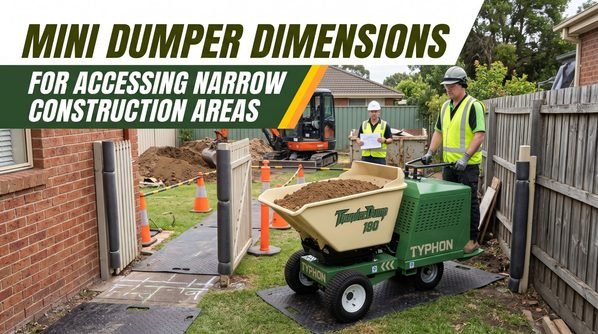
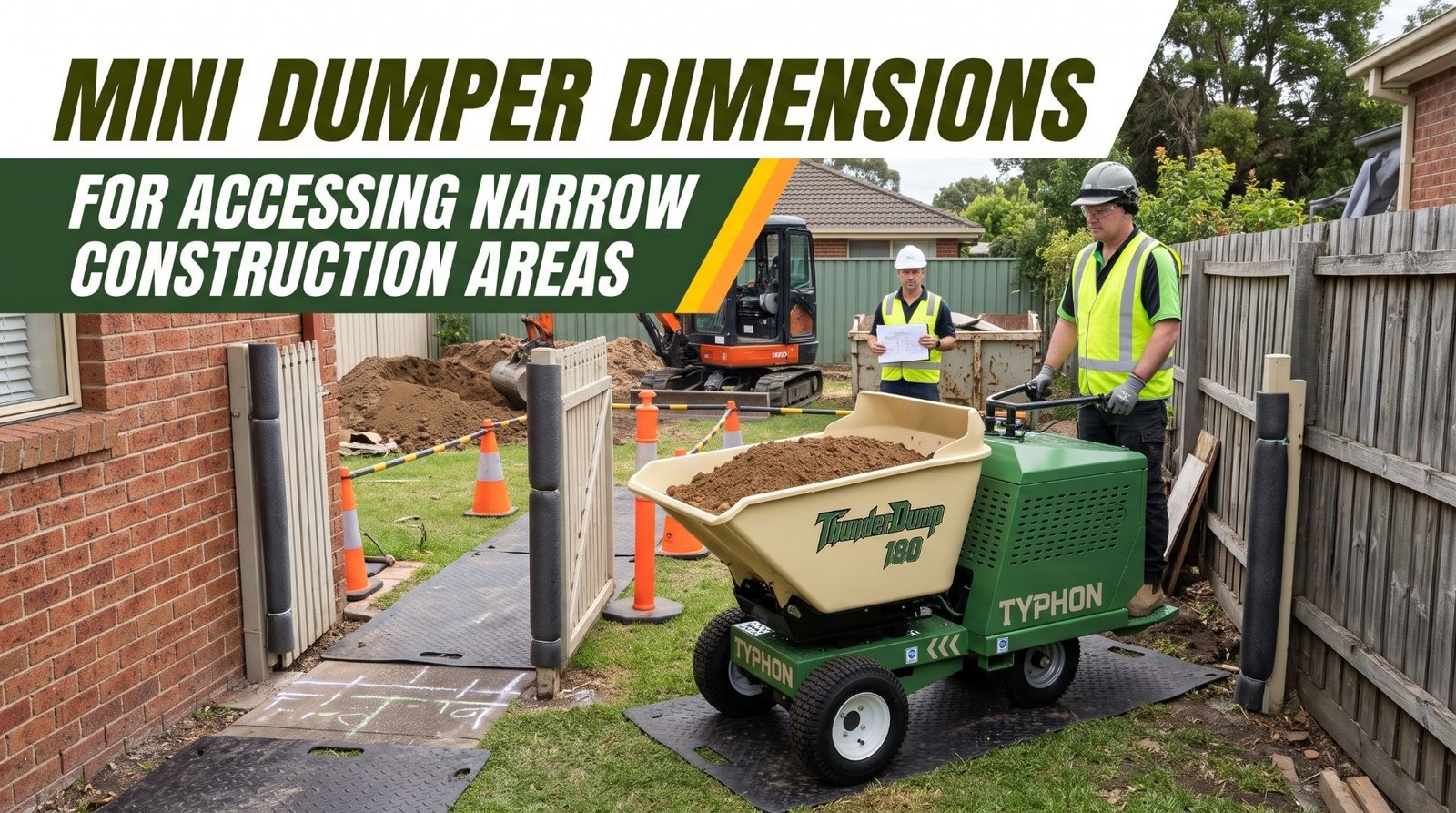
Mini Dumper Dimensions for Accessing Narrow Construction Areas
Some of the most demanding material handling jobs happen in the smallest spaces. Backyard landscaping, residential extensions, basement renovations, urban infill projects, and courtyard repairs all share the same challenge: soil, aggregate, concrete, and debris must move through gates, side passages, and doorways that a skid steer or site dumper can’t fit through. Mini dumpers fill that gap. Their compact frames let crews replace wheelbarrows and manual hauling with powered transport, which saves labor, speeds up the job, and reduces strain on workers.
Choosing the right mini dumper starts with dimensions, but overall width is only the first number to check. A machine that slips through a garden gate may still be too long to turn at the corner of the house. It may be too tall for a covered walkway, or its chassis may catch on a raised threshold. Some machines reach the tipping area and then lack the space or overhead clearance to unload. Every dimension interacts with the site, and a single overlooked measurement can turn a well-planned job into a day of manual hauling.
Measuring Overall Width Against Site Entrances
Overall width is usually the first dimension buyers check, and for good reason. If the machine can’t pass the narrowest point on the route, nothing else matters. Many mini dumpers are designed specifically for restricted access, and some of the narrowest models measure under 30 inches wide. That lets them pass through many standard garden gates and doorways. Widths vary considerably between models and configurations, though, so the published figure must be compared against careful measurements of your actual site.
Start by walking the full route from the unloading point or material stockpile to the work area. Measure the narrowest point, not just the main entrance. Restrictions often appear where you least expect them:
- Gates and gate posts, including hinges, latches, and gates that don’t open fully
- Doorways and door frames, including thresholds and door stops
- Side passages between buildings, fences, and walls
- Downspouts, utility meters, and wall-mounted fixtures that protrude into the path
- Landscaping features, such as planters, steps, retaining walls, and tree trunks
- Temporary obstacles, such as scaffolding, stacked materials, and parked equipment
Measure at more than one height. A passage may be wide at ground level but narrowed by a window sill, meter box, or overhanging shrub at the height of the skip or operator controls.
Then compare these measurements with the machine’s widest point in its operating configuration. Check whether the published width includes tires, tracks, skip edges, side-mounted controls, and mirrors. Some machines have adjustable or extendable track frames, so confirm the width in both the narrow travel setting and the wider working setting.
Never choose a machine that fits with almost no room to spare. Allow enough clearance on each side for controlled movement, steering corrections, and uneven ground that may cause the machine to drift. A route that leaves an inch on each side forces slow, stressful travel and risks damage to the machine, the property, and the operator’s hands. Protect vulnerable surfaces such as door frames and painted walls with padding where clearance is tight, and remove temporary obstacles before work begins.
Key takeaway: Measure the narrowest point along the entire route, at several heights, and choose a machine whose widest operating dimension leaves comfortable clearance for safe, controlled travel.
Checking Machine Length and Turning Space
A mini dumper that passes through a narrow gate still has to turn, reverse, and reposition once it’s inside. Overall length directly affects how easily the machine changes direction, and it’s often the dimension that causes problems after width has been confirmed.
Longer machines need more space to turn, especially at corners where a side passage meets a rear garden or where a path bends around a building. A 90-degree corner in a narrow passage is one of the most common access challenges on residential jobs. A machine that’s narrow but long may fit along the straight section and then become stuck at the turn.
Plan the route to reduce reversing and repeated multi-point turns. Each correction adds time, increases the risk of contact with structures, and adds wear to tracks and tires. Where the machine must reverse, use a spotter if visibility is limited, and keep pedestrians out of the travel path.
Key takeaway: Check turning radius and steering design alongside overall length, map every corner on the route, and plan travel so the machine can turn and reposition without repeated reversing or contact with structures.
Evaluating Height and Overhead Clearance
Height becomes critical when the route passes under door frames, covered walkways, carports, balconies, low tree branches, scaffolding, or temporary site structures. It becomes even more important at the tipping point, where some machines raise their skip far above their travel height.
Measure overhead clearance at the lowest point along the travel route and at the unloading location. Don’t forget items that change during the job, such as scaffold boards, temporary roofing, tarps, and branches that sag when wet.
Overhead power lines present one of the most serious hazards on any site. Never raise a skip or high-tip body beneath or near power lines. Identify all overhead lines before work begins, keep the machine and its raised components outside the minimum approach distance required by local regulations, and use a spotter where lines are nearby. In the United States, OSHA generally requires equipment to stay at least 10 feet from lines rated up to 50 kV, with greater distances for higher voltages. When in doubt, contact the utility provider before work starts.
Indoor and basement work also requires attention to ceiling height, lighting fixtures, ductwork, and pipes. Confirm that engine-powered machines are suitable for enclosed spaces, as exhaust can create dangerous conditions. Electric or battery-powered mini dumpers are often the preferred choice for indoor work, subject to the manufacturer’s guidance and site ventilation requirements.
Key takeaway: Measure travel, tipping, and high-tip heights against the lowest overhead point on the route and at the unloading area, and never raise a skip beneath or near overhead power lines.
Ground Clearance and Uneven Access Routes
Narrow access routes are rarely smooth. Side passages may include steps, raised thresholds, concrete edges, drainage channels, tree roots, paving slabs at different heights, and patches of soft lawn. Ground clearance determines how well the machine passes over these obstacles without its chassis making contact.
Low clearance increases the chance of the underside striking raised stones, curbs, or the crest of a ramp. Contact can damage hydraulic lines, drive components, and the frame, and it can leave the machine high-centered with its tracks or wheels unable to grip. High clearance helps on rough ground but can raise the machine’s center of gravity, which affects stability on slopes.
Where steps or thresholds can’t be avoided, use properly rated ramps that are wide enough, secured against slipping, and designed for the machine’s loaded weight. Use ground protection mats on soft lawns and finished surfaces to spread the load and prevent ruts. Follow the manufacturer’s slope limits for both loaded and unloaded travel. Many manufacturers recommend traveling straight up and down slopes, with the load positioned according to the operator’s manual, rather than crossing them.
Key takeaway: Check ground clearance together with machine length, tire or track design, and loaded weight, and prepare uneven routes with rated ramps and ground protection so the machine travels without striking or sinking.
Comparing Wheel and Track Configurations
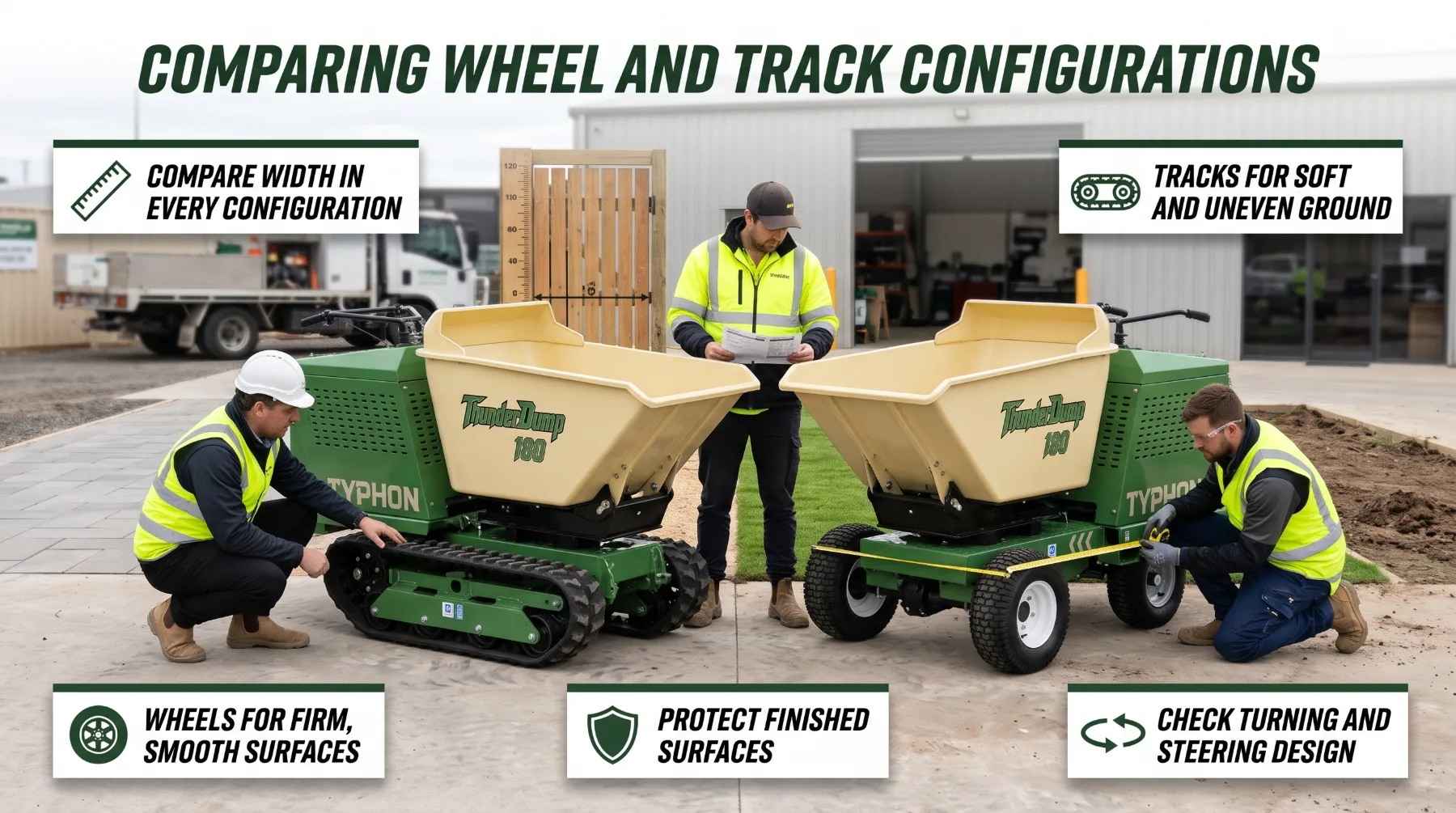
Mini dumpers are available with wheels or tracks, and the choice affects width, maneuverability, traction, surface protection, and the types of sites where the machine performs best. Neither option suits every job, so the conditions on your typical sites should guide the decision.
Wheeled mini dumpers generally suit firm, relatively smooth surfaces:
- Often faster on paved paths, concrete, and compacted gravel
- Typically cause less scuffing on finished surfaces during straight travel
- May be simpler to maintain, with fewer undercarriage components
- Can lose traction on soft, wet, or steep ground
- Concentrate weight on smaller contact patches, which can rut soft lawns
Tracked mini dumpers often suit soft, uneven, or sloping sites:
- Spread weight over a larger contact area, reducing ground pressure on soft soil and turf
- Provide strong traction on mud, loose soil, and many slopes within the manufacturer’s limits
- Can often pivot or turn tightly with skid steering, which helps in confined areas
- May scuff or mark finished surfaces during tight turns
- Require regular undercarriage inspection for track wear, tension, and debris buildup
Width is a key comparison point. Track frames and wheel tread widths vary, and some tracked models offer adjustable track width that narrows for access and widens for stability on site. Check the machine’s width in every available configuration and confirm which setting the manufacturer requires for loaded travel and tipping.
Surface protection matters on residential and commercial properties. Rubber tracks usually cause less damage than steel, but counter-rotating turns on lawns and pavers can still leave marks. Wheeled machines may be gentler on hard surfaces but can rut soft ground. Ground protection mats, wide gradual turns, and planned routes reduce damage with either configuration.
Consider the full range of jobs you handle. A contractor working mainly on paved urban sites may favor wheels, while one working on landscaping and garden projects may rely on tracks. For mixed workloads, choose the configuration that suits most of your work, and rent the alternative for exceptions.
Key takeaway: Wheels generally suit firm, smooth surfaces while tracks suit soft, uneven, and sloping ground, so compare width in every configuration, traction needs, and surface protection against the sites you work on most.
Matching Dimensions to Loading and Tipping Areas
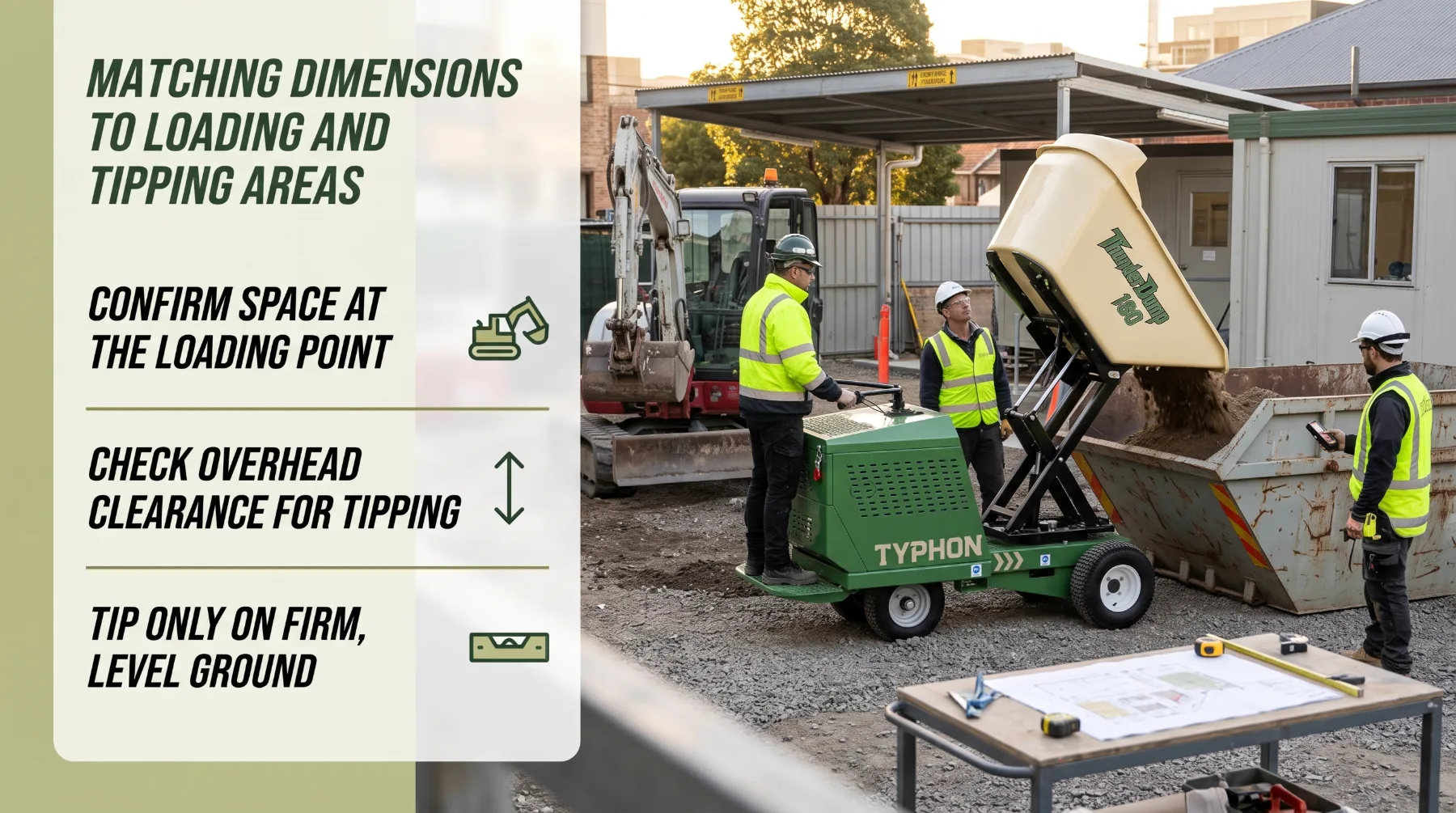
Getting through the entrance is only part of the job. A mini dumper must also fit where it loads, travel loaded along the route, and discharge material safely at the tipping point. A machine that reaches the work area but can’t unload efficiently will slow every cycle.
Next, consider the loaded machine. Width and height don’t change much when loaded, but stability and handling do. Narrow machines carrying dense materials such as wet soil, concrete, or crushed stone need careful travel, especially on slopes and uneven ground. Never exceed the rated payload, and remember that a full skip of dense material may reach the weight limit before it reaches the brim.
Allow enough room for the operator to approach, tip, and leave without repeated maneuvering. If the tipping point is cramped, consider relocating the stockpile or skip container, or choose a machine with a discharge style that suits the space.
Key takeaway: Confirm that the machine fits the loading point, travels safely when loaded, and has the space, ground support, and overhead clearance required by its discharge style at the tipping area.
Conclusion
Mini dumper dimensions decide whether a machine can work productively and safely on a restricted construction site. Overall width must clear the narrowest point on the entire route with comfortable margin, while length and turning radius determine whether the machine can negotiate corners and reposition without repeated reversing. Travel, tipping, and high-tip heights must clear every overhead obstruction, and power lines demand strict separation at all times. Ground clearance, ramps, and ground protection keep the machine moving over steps, thresholds, and soft ground. Wheel and track configurations each suit different surfaces, and the right choice depends on the sites you work on most. Proper maintenance, including regular inspections of the tracks, wheels, hydraulic system, engine, and tipping mechanism, helps maintain reliable performance, safe operation, and long-term service life. Loading and tipping areas need as much attention as the entrance itself. Before your next job, walk the full route with a tape measure, record widths, heights, corners, and surface conditions, and compare them against the manufacturer’s dimensions for each configuration. Also, follow the recommended maintenance schedule to prevent unexpected breakdowns and keep your mini dumper ready for daily work. Careful measurement and proper maintenance prevent access problems, protect property, and keep your crew moving material safely from the first load to the last.
Frequently Asked Questions
Which mini dumper dimension is most important for narrow access?
Overall width is the essential starting point, because the machine must pass the narrowest point on the route with safe clearance. However, width alone doesn’t guarantee access. Length and turning radius determine whether the machine can negotiate corners, and height must clear door frames, walkways, and overhead structures. Ground clearance affects travel over steps and thresholds. The safest approach is to measure the entire route and compare every relevant dimension against the manufacturer’s figures for the exact configuration you plan to use.
Why does turning radius matter?
Turning radius determines how much space the mini dumper needs to change direction. Narrow access routes often include tight corners where a side passage meets a garden or where a path bends around a building. A machine that fits along a straight passage may still be unable to turn at the corner. Steering design also matters, as skid-steer tracked machines can often turn in a tighter footprint than wheeled models with front- or rear-wheel steering. Checking turning radius helps you avoid repeated reversing and contact with structures.
Should buyers check dumper height before entering a building?
Yes. Compare the machine’s travel height with door frames, ceilings, ductwork, lighting, and other overhead features along the route. If the machine will tip indoors, confirm that the raised skip clears everything above it, especially on high-tip models. Check whether a foldable ROPS may be lowered for access and follow the manufacturer’s rules on when that’s permitted. For indoor work, also confirm the power source is suitable, since engine exhaust in enclosed spaces can create serious hazards.
Are tracked mini dumpers better for every narrow site?
No. Tracked machines often perform well on soft, uneven, or sloping ground, spread weight to reduce ground pressure, and can turn tightly with skid steering. Wheeled machines can be faster and gentler on firm, paved, or finished surfaces. Track width, adjustable track settings, surface protection needs, and ground conditions all influence suitability. The right choice depends on the sites you work on most often, so compare complete machine dimensions and traction needs rather than assuming one configuration suits every job.