Safe Tri-Loader Operation Around Buildings, Workers, and Obstacles
Safe Tri-Loader Operation Around Buildings, Workers, and Obstacles
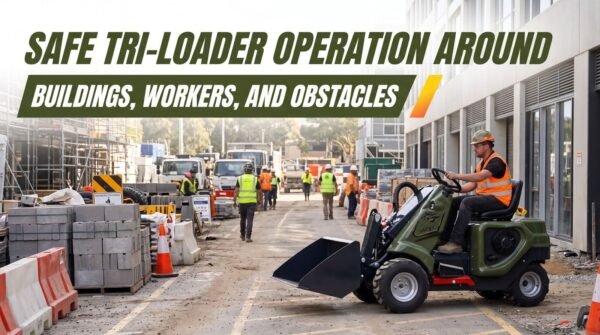
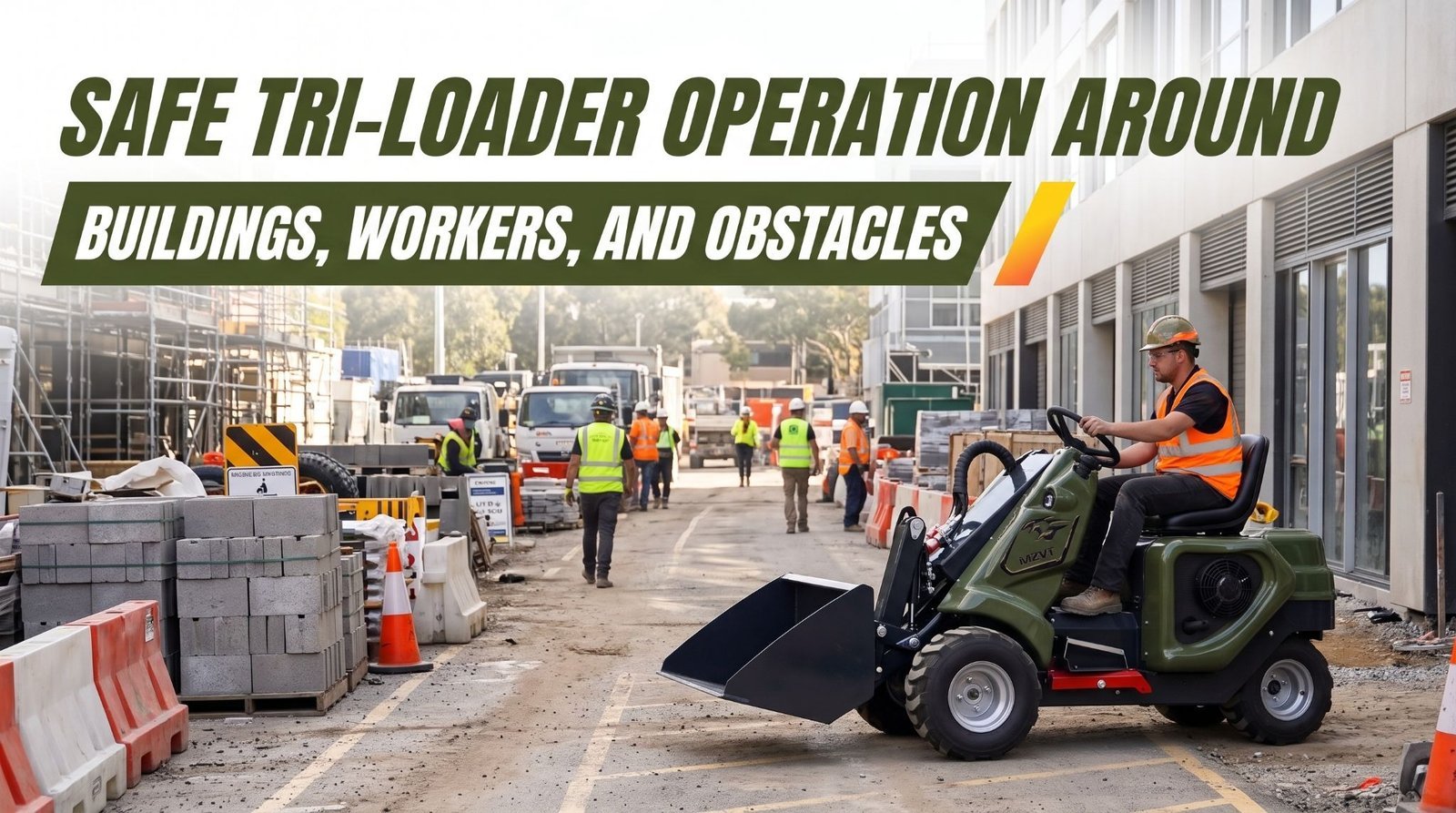
Tri-loaders often work where space is tight and activity is constant. On a residential build, a renovation project, or a commercial site, the machine may load spoil beside a foundation, carry pallets of blocks along a narrow path, or move gravel between parked vehicles and stacked materials. In each case, buildings, workers, vehicles, and stored materials share limited space, and the loader has to move through it all.
Compact size and nimble handling are what make tri-loaders valuable in these settings. They are also what bring the machine into close range of the people and structures around it. A loaded bucket swinging near a wall, a turn made without checking behind the machine, or a worker who steps into the travel path at the wrong moment can turn a routine task into a serious incident. Collisions with buildings cause costly damage and delays. Contact with a person can cause life-changing injuries.
Safe operation in these conditions does not happen by chance. It comes from a clear travel plan, controlled attachment movements, good visibility, and steady coordination with everyone nearby. When those elements are in place, the tri-loader works efficiently and predictably, and crews can trust the machine operating beside them.
Visibility Around Structures
An operator can only avoid what they can see. Around buildings and stored materials, visibility from the seat becomes limited quickly, and blind spots grow larger than many crews realize.
Check the full machine path before moving. Look in every direction the machine will travel, including behind it before reversing. Use mirrors and cameras where fitted, and keep them clean and correctly adjusted from the operating position. Sound the horn before moving off and at blind corners and doorways where site rules call for it.
Move slowly wherever visibility is limited. Lower speed gives the operator more time to react and gives workers more time to notice the machine. Approach corners wide where space allows, and stop before entering an area you cannot see into clearly.
The spotter must remain in a safe position where the operator can see and communicate with them. If the spotter moves out of view, gives an unclear signal, or is distracted, the operator stops all movement until communication is restored.
Lighting matters as well. Early mornings, evenings, overcast days, and work inside partially enclosed structures reduce contrast and hide hazards. Use work lights where fitted, and add temporary lighting to dim areas along the route.
Key takeaway: Buildings, walls, stacked materials, and attachments create blind spots, so check the full machine path before every movement, use mirrors and cameras where fitted, and use a trained spotter who stays safe, visible, and in clear communication with the operator.
Managing Workers and Pedestrians
On a busy jobsite, the tri-loader shares space with laborers, tradespeople, supervisors, delivery drivers, and sometimes members of the public. Every person on foot near a moving machine is at risk, and that risk is greatest when the operator and the worker each assume the other has seen them.
Keep people outside the loader’s operating and turning area. Establish an exclusion zone around the machine that covers:
- The travel path: The full width of the route the loader will follow, with clearance on each side.
- The turning area: The space the front, rear, and attachment sweep through when the machine changes direction.
- The loading and unloading points: Areas where material is picked up, lifted, and placed.
- The attachment’s reach: The space the bucket or attachment occupies as it raises, lowers, or tilts.
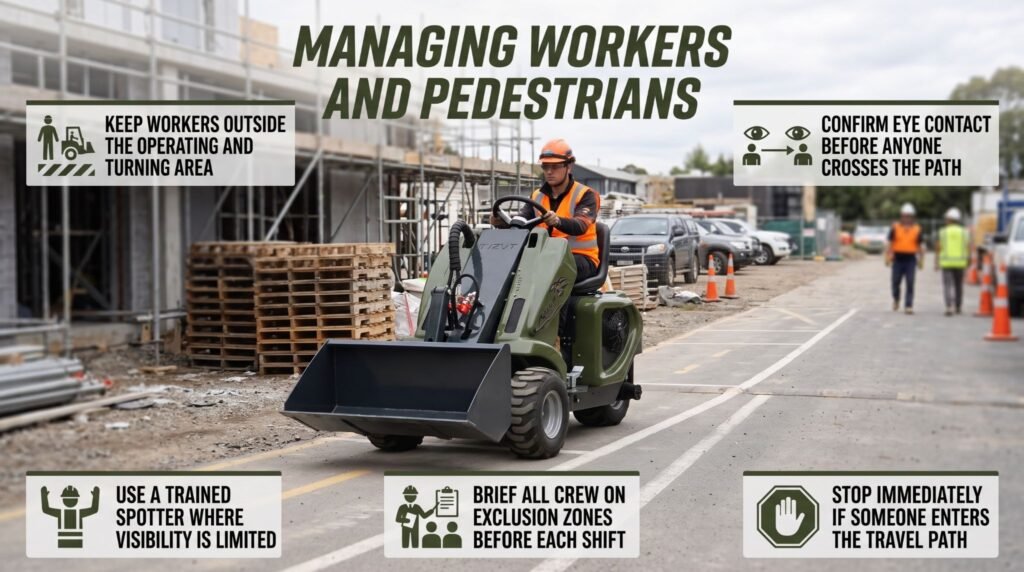
Mark the zone with cones or barriers where practical, and brief everyone on site before work begins. Workers should understand where the loader will operate, which areas are off limits while it is moving, and how to approach the machine safely when they need to.
Stop immediately if someone enters the machine’s path or the operator loses sight of the spotter. Lower the load, hold the machine stationary, and resume only after the area is clear and communication is restored. A few seconds of waiting is always better than continuing with uncertainty.
Only the operator should ride on the machine. Never carry passengers on the loader, in the bucket, or on any attachment, and never use the bucket to lift people.
Start-of-shift briefings help keep everyone aligned. Cover the day’s travel routes, unloading areas, exclusion zones, and any changes to site layout. Encourage workers to report near misses and congestion points so supervisors can address them before they lead to incidents.
Key takeaway: Keep people outside the loader’s operating and turning area, set clear communication rules before anyone approaches the machine, and stop immediately whenever someone enters the path or the operator loses sight of the spotter.
Load Height and Stability
How a tri-loader carries its load has a direct effect on both visibility and stability. A load carried too high blocks the operator’s view and raises the machine’s center of gravity. A load carried during sharp turns or sudden stops can shift and destabilize the machine without warning.
Carry material low enough to maintain visibility and stability during travel. Keep the bucket or attachment as low as practical while maintaining ground clearance, with the bucket rolled back to hold the load securely. A low load keeps the center of gravity down, improves the operator’s forward view, and reduces the chance of material spilling onto the route.
Raise the attachment only when positioned for the intended placement or unloading task. Lifting the load while traveling increases sensitivity to slopes, bumps, and turns, and it blocks the operator’s view of the path ahead. Approach the unloading point slowly and squarely, stop, and then raise the load.
Always wear the seat belt and keep the operator restraint system in place. These systems keep the operator inside the protective structure if the machine tips or stops suddenly.
Key takeaway: Carry loads low and rolled back during travel, raise the attachment only when positioned to place or unload, stay within rated capacity, and avoid sudden turns or hard braking with a load.
Work Area and Travel Route
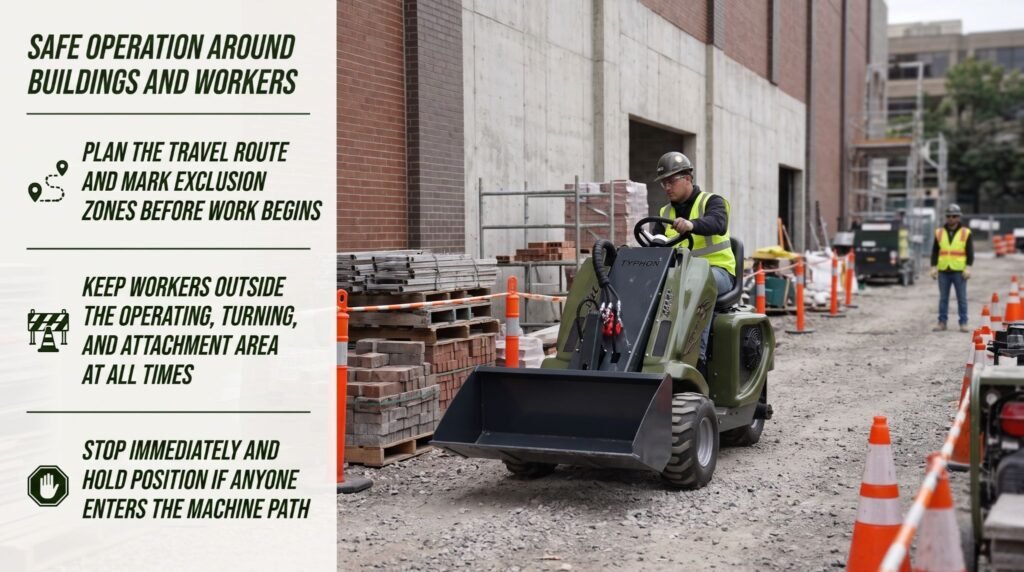
Safe tri-loader operation begins before the engine starts. A clear understanding of the work area, and a planned route through it, prevents most of the close calls that happen on busy sites. Operators who know exactly where they are going, and what lies along the way, can focus on controlling the machine rather than reacting to surprises.
Check each part of the route for hazards. Look for uneven ground, soft spots, trenches, curbs, ramps, overhead lines, low branches, and changes in surface level. Note doorways, corners, and gaps between structures where visibility drops or clearance tightens. Confirm that the route can support the machine and its heaviest expected load.
Remove unnecessary obstacles before work begins. Stray pallets, loose materials, tools, hoses, and debris narrow the route and create tripping and collision hazards. Where obstacles must stay in place, such as stored materials, scaffolding, or parked equipment, mark them clearly so the operator can see them from the seat.
Keep travel paths separated from pedestrian routes wherever practical. Dedicated walkways, marked crossings, and barriers between foot traffic and machine traffic are among the most effective safety measures on any shared site. Where full separation is not possible, plan crossing points with good sightlines and clear rules for who yields.
Review the route as the job progresses. Deliveries arrive, stockpiles grow, excavations open, and new trades start work. A route that was clear in the morning may be blocked or hazardous by the afternoon.
Key takeaway: Plan the loading area, travel route, turning points, and unloading destination before moving material, remove unnecessary obstacles, mark restricted areas clearly, and keep machine travel separate from pedestrian routes wherever practical.
Working Near Walls and Obstacles
Tri-loaders frequently work within arm’s reach of structures. They load material beside foundations, place pallets near walls, and travel between columns, parked vehicles, and stored materials. In these conditions, a small misjudgment can damage a building, break a window, or crush a worker against a fixed object.
Approach walls, columns, parked vehicles, and stored materials slowly. Reduced speed gives the operator time to judge distance, correct the machine’s position, and stop before contact. Approach squarely where possible, since an angled approach makes clearance harder to judge.
Identify vulnerable features before working near a structure. Windows, doors, downspouts, utility meters, gas lines, electrical conduits, air conditioning units, and exterior lighting often sit at bucket height. Mark them, protect them with barriers or padding where practical, and brief the crew on their locations.
Never allow workers to stand between the machine and a wall, column, vehicle, or stack of materials. These pinch points leave no escape if the machine moves unexpectedly. Keep people clear of the space between the loader and any fixed object at all times.
Avoid using the bucket or attachment to push against a building unless the machine and task are specifically designed for that operation. Pushing on walls, prying at structures, or nudging stored materials can damage the building, overload the attachment, and destabilize the machine. Use the right equipment and method for each task.
Watch the ground near structures as well. Backfill around new foundations may be soft or poorly compacted, and drainage covers, window wells, and utility boxes may not support machine weight. Keep wheels on firm ground and away from excavation edges.
Key takeaway: Approach walls and obstacles slowly, allow clearance for the attachment and the machine’s rear and side movement, keep workers out of pinch points, and never push against a building unless the machine and task are designed for it.
Inspection and Operator Controls
A tri-loader working near buildings and people needs to respond exactly as the operator expects. A sticking control, weak brake, or drifting hydraulic function can turn a controlled movement into a collision. A thorough inspection before every shift, and steady control technique throughout the job, keep the machine predictable.
Inspect the machine before work with it parked on firm, level ground, the attachment lowered, the parking brake applied, the engine off, and the key removed:
- Steering: Confirm smooth, responsive steering with no excessive play.
- Brakes: Test the service brake and parking brake for correct function.
- Tires or tracks: Check for cuts, wear, damage, and correct inflation or tension.
- Hydraulic functions: Inspect hoses, fittings, and cylinders for leaks, abrasion, cracks, and loose connections. Use a piece of cardboard rather than your hand to check for leaks, since pressurized fluid can penetrate the skin and cause serious injury.
- Attachment locks: Confirm the quick coupler or mounting pins are clean, undamaged, and fully engaged. An attachment that is not fully locked can detach under load.
- Warning devices: Test the horn, lights, backup alarm, and any beacons.
- Mirrors and cameras: Clean and adjust them from the operating position.
- Seat belt and restraints: Confirm the seat belt latches and releases properly and shows no damage.
Once the engine is running, test each control in a clear area. Confirm that lift, tilt, travel, and steering functions respond smoothly, return to neutral when released, and hold position without drifting. Check that the emergency stop and any safety interlocks work as intended.
Report any defect that affects safe operation, and keep the machine out of service until it has been corrected. Never operate a loader with faulty brakes, unreliable steering, or a leaking hydraulic system near people or structures.
Use smooth control inputs and follow the manufacturer’s operating instructions. Gentle, deliberate movements improve precision, reduce stress on hydraulic and structural components, and give nearby workers time to see what the machine is doing. Abrupt inputs make the machine harder to predict and increase the chance of losing control of a load.
Operators should be trained on the specific tri-loader model before use, including its controls, capacity, and limits. Familiarization matters even for experienced operators, since control layouts and features vary between machines.
Stop and reassess when the ground, visibility, or site traffic changes. Rain can soften surfaces, deliveries can block routes, new trades can enter the work area, and fading light can hide hazards. Each change calls for a fresh look at the plan before work continues.
Key takeaway: Inspect steering, brakes, tires or tracks, hydraulic functions, attachment locks, and warning devices before every shift, use smooth control inputs, and stop to reassess whenever ground, visibility, or site traffic changes.
Conclusion
Safe tri-loader work around buildings and people relies on route planning, visibility, communication, and careful load control. Mapping the loading area, travel route, turning points, and unloading destination before work begins, and marking obstacles and restricted areas, keeps movements predictable. Checking the full machine path, using mirrors and cameras, and working with a trained spotter address the blind spots that buildings and stored materials create. Clear exclusion zones and firm communication rules keep workers outside the operating and turning area, and stopping immediately when someone enters the path protects lives. Carrying loads low, staying within rated capacity, and avoiding sudden turns preserve stability and visibility. Slow approaches and generous clearance for the attachment and the machine’s rear and side movement protect walls, vehicles, and stored materials. A thorough pre-use inspection and smooth control technique keep the machine responding exactly as expected. When you apply these practices on every shift, keeping workers clear and operating slowly near obstacles helps reduce collision and material-handling risks, so your crew can work with confidence alongside the machine.
FAQs
Can a tri-loader operate near pedestrians?
Only when a safe separation and site traffic plan are maintained. Workers should stay outside the operating area, including the travel path, turning area, and attachment reach. Separate walkways from machine routes wherever practical, use marked crossings with good sightlines, and require workers to make eye contact with the operator and receive a clear signal before approaching.
When is a spotter needed?
Use one when the operator’s view is restricted or the task requires guidance around structures and obstacles. Common situations include reversing, working near walls and corners, moving between stacked materials, and placing loads in tight spaces. The spotter must stay in a safe position outside the machine’s path, remain visible to the operator, and use signals agreed before work begins.
Should a tri-loader travel with a raised bucket?
Keep the load low during travel and raise it only when needed for placement or unloading. A low, rolled-back bucket keeps the center of gravity down and preserves the operator’s forward view. Travel to the unloading point, stop, and then raise the load. Avoid sudden turns and hard braking whenever the machine is carrying material.
What should happen if a worker enters the travel path?
Stop movement immediately and resume only after the area is clear and communication is restored. Lower the load and hold the machine stationary. The same rule applies if the operator loses sight of the spotter. Confirm with the worker or spotter that the path is clear before moving again, and report repeated incursions so the site plan or exclusion zones can be improved.