Wheel Loader Bucket Types Explained: Choose the Right Tool
Equipping your heavy machinery with the proper tools directly impacts your job site productivity, safety, and operational profitability. While a wheel loader provides the raw hydraulic power and mobility necessary to move earth, the bucket dictates how efficiently that energy translates into actual work. Using the wrong bucket for your specific application forces your machine to work harder, burns excess fuel, and significantly increases the risk of premature mechanical failure.
We understand that maximizing your equipment investment requires clear, expert guidance. Selecting the right attachment involves much more than simply finding a bucket that fits your machine’s coupler. You must calculate material weights, evaluate your ground conditions, and understand the structural differences between various bucket profiles.
This comprehensive guide explains everything you need to know about wheel loader buckets. We will explore the specific designs and applications of general-purpose buckets, light material buckets, rock buckets, and multi-purpose buckets. By the end of this guide, you will possess the knowledge needed for choosing the right bucket to match your exact job site requirements and machine capacity.
The Importance of Choosing the Right Bucket
Every material handling task presents unique physical challenges. Moving wet, dense clay requires vastly different equipment capabilities than loading dry wood chips or pushing snow. When you dedicate time to understanding bucket types, you protect your machinery and your bottom line.
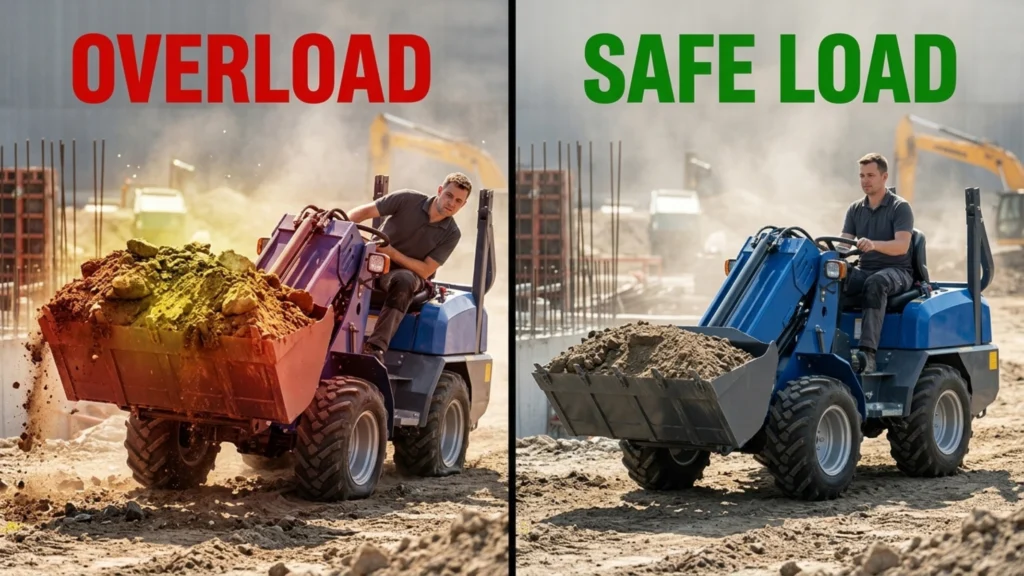
Using an undersized bucket for a light material wastes time. Your operator will need to make twice as many passes to load a truck, doubling the fuel consumed and the hours put on the engine. Conversely, using an oversized bucket for heavy materials like wet sand or blasted rock creates an incredibly dangerous situation. Overloading the machine exceeds its safe operating capacity, lifting the rear wheels off the ground and putting the operator at serious risk of a rollover accident.
Choosing the right bucket ensures you hit your target payload in the fewest number of passes possible without compromising safety. This precise alignment between machine, attachment, and material is the cornerstone of professional fleet management and operational efficiency.
Essential Wheel Loader Bucket Types
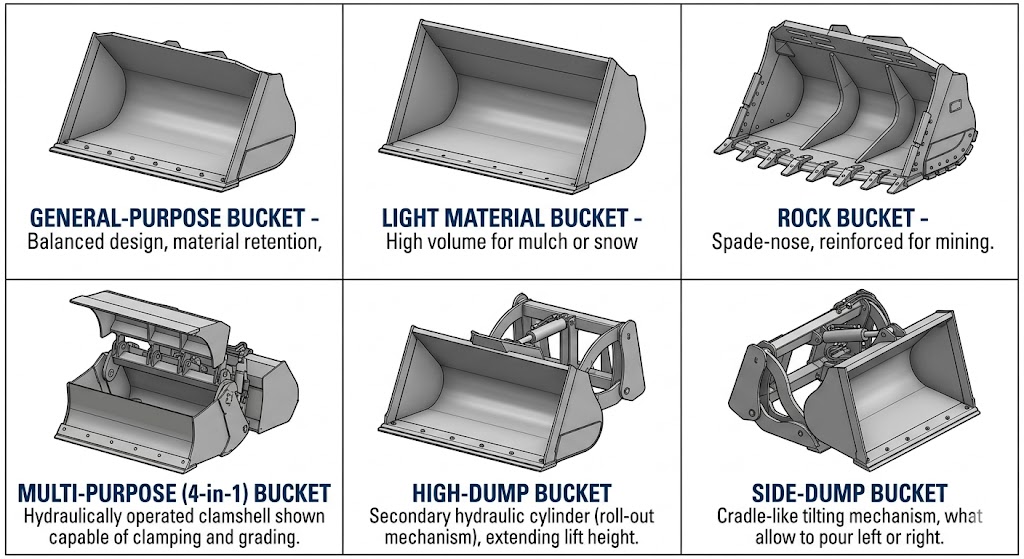
Manufacturers design wheel loader buckets with particular shapes, sizes, and extra strength to work with different types of materials. Understanding the strengths and limitations of these bucket types allows you to outfit your fleet for maximum versatility and performance.
General-Purpose Buckets
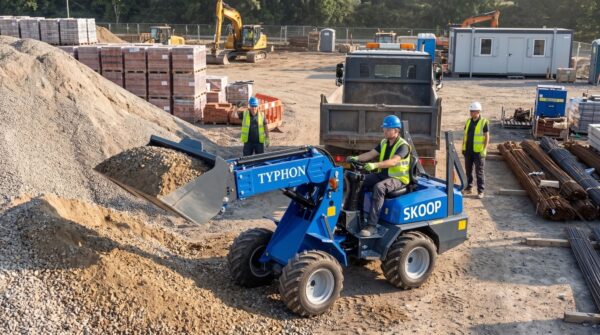
General-purpose buckets serve as the industry standard for most earthmoving and construction applications. If you purchase a new wheel loader off the dealership lot, it likely comes equipped with this versatile attachment.
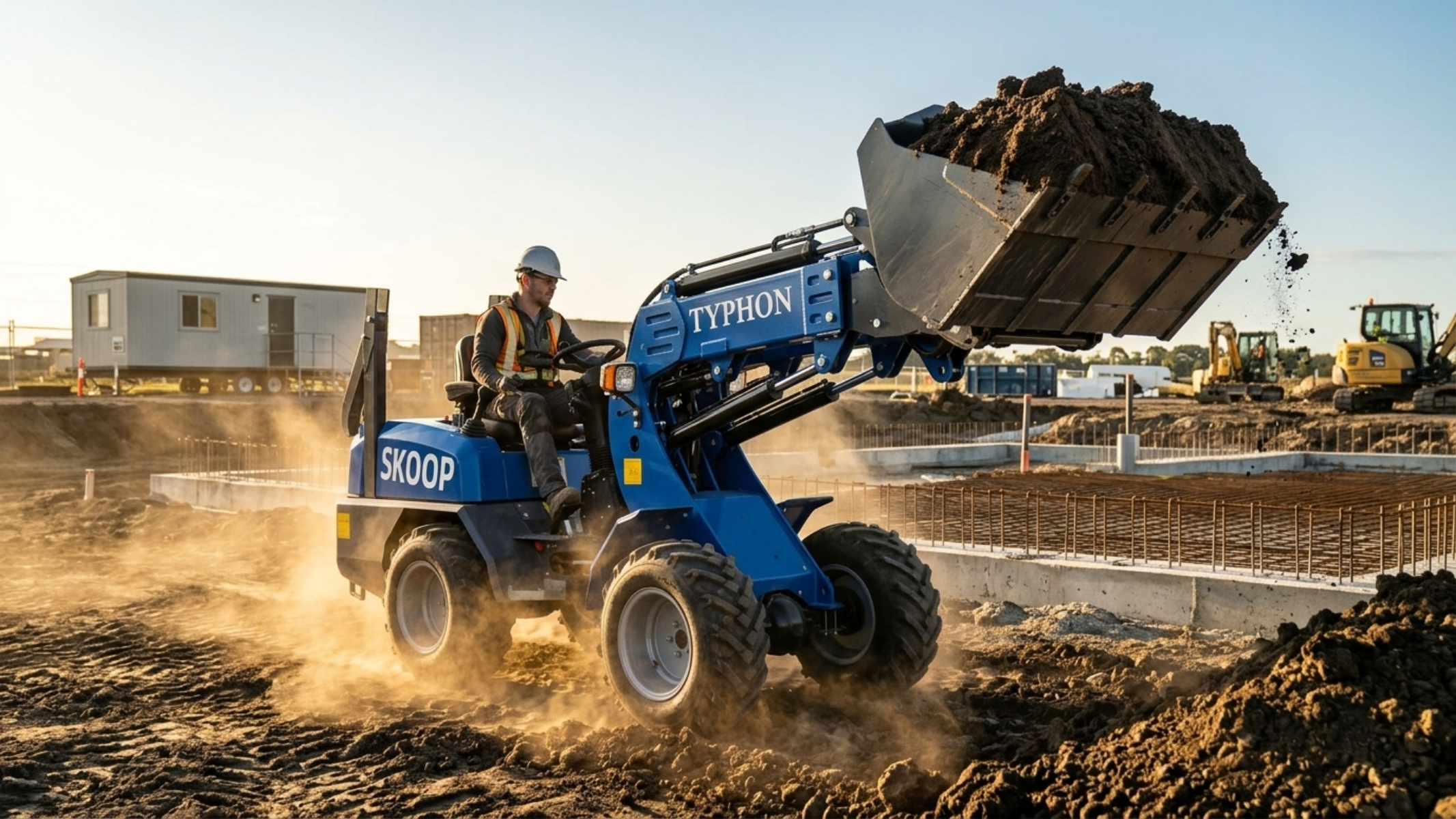
These buckets feature a balanced design intended to handle a wide variety of medium-density materials. They typically feature a curved side profile that promotes excellent material retention, preventing loose dirt or gravel from spilling over the sides during transport. The bottom profile is designed to glide smoothly over the ground, making it easier for operators to grade surfaces or backdrag loose soil.
Primary Applications:
- Load loose dirt, topsoil, and medium-density gravel.
- Stockpiling materials in supply yards.
- Basic site grading and backfilling trenches.
- Moving palletized materials (when equipped with fold-over forks, though dedicated pallet forks are preferred)
Key Advantages: The primary advantage of the general-purpose bucket is its flexibility. For smaller contractors who only own one wheel loader, this bucket allows them to tackle 80% of standard job site tasks effectively. It offers a solid balance between holding capacity and breakout force, ensuring reliable performance across a variety of common construction scenarios.
Light Material Buckets
When your operation handles massive volumes of low-density materials, a general-purpose bucket will severely limit your productivity. Light material buckets are specifically engineered to maximize the volume of material moved per cycle without exceeding the loader’s weight capacity.
These buckets feature a significantly larger capacity than standard buckets. They achieve this goal through a higher back plate, extended side panels, and a deeper floor. Because the materials they handle weigh very little per cubic yard, the structural steel used in these buckets does not need to be as thick or heavily reinforced as a rock bucket, keeping the attachment empty weight relatively low.
Primary Applications:
- Agricultural operations handling feed, grain, or dry fertilizer.
- Landscaping supply yards moving dry mulch, peat moss, or wood chips.
- Municipalities conduct large-scale snow removal operations.
- Waste transfer stations handling loose paper, plastic, and light refuse.
Key Advantages: Efficiency defines the light material bucket. By maximizing the volume held in a single pass, operators load high-sided trucks and agricultural hoppers much faster. This reduces cycle times, lowers fuel consumption, and allows your crew to process far more material in a standard shift.
Rock Buckets
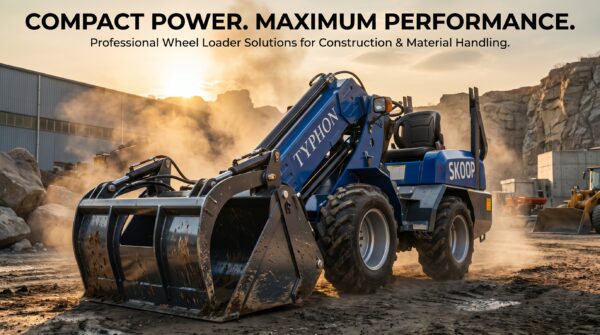
Quarries, mines, and demolition sites present the most aggressive, punishing environments on earth. Moving blasted rock, concrete slabs, and highly abrasive ores will destroy a standard bucket in a matter of weeks. Rock buckets are built exclusively to survive these extreme conditions.
These tools feature massive structural reinforcements. They utilize high-strength, abrasion-resistant steel (such as AR400 or AR500) on the cutting edges, side plates, and bottom wear pads. The profile typically features a spade-nose (V-shaped) cutting edge rather than a straight edge. This spade design focuses on the machine’s entire breakout force onto a smaller surface area, allowing the bucket to penetrate tightly compacted rock piles with ease.
Primary Applications:
- Quarry operations loading blasted limestone, granite, or trap rock.
- Demolition sites have cleared heavy concrete rubble and rebar.
- Heavy highway construction is moving ripraps and large boulders.
- Mining operations handle dense, abrasive ores.
Key Advantages: Unmatched durability sets the rock bucket apart. While they cost significantly more upfront than a general-purpose bucket, their reinforced construction prevents catastrophic failure and costly downtime. The specialized rock teeth and spade-nose design reduce the strain on the loader’s hydraulic system by making it easier to pry loose heavy, interlocking materials.
Multi-Purpose (4-in-1) Buckets
For contractors who demand ultimate versatility from a single attachment, the multi-purpose bucket—frequently called a 4-in-1 bucket—delivers exceptional value. This unique tool features a hydraulically operated clamshell design that splits the bucket into two pieces.
By manipulating the hydraulic controls inside the cab, the operator can use this attachment in four distinct ways: as a standard bucket for loading, as a dozer blade for pushing material (by opening the bucket entirely), as a grapple for picking up bulky items (by clamping down on them), and as a scraper for leveling terrain.
Primary Applications:
- Site preparation and land clearing operations.
- Municipal public works departments handle diverse daily tasks.
- Disaster cleanup: picking up irregular debris and fallen trees.
- General contracting requires frequent transitions between grading and loading.
Key Advantages: The multi-purpose bucket eliminates the need to constantly switch between different attachments or bring multiple machines to a single job site. It allows an operator to push a pile of dirt, grab a massive tree stump, and load a truck with gravel all within a few minutes. While heavier and more mechanically complex than a standard bucket, the operational flexibility it provides is invaluable.
High-Dump Buckets
Certain logistical setups require machines to load materials into exceptionally tall hoppers, walking-floor trailers, or rail cars. When a standard wheel loader lacks the necessary hinge-pin height to clear these obstacles, a high-dump bucket provides the perfect solution.
Also known as roll-out buckets, these attachments feature a secondary hydraulic cylinder mechanism built directly into the bucket frame. Instead of relying solely on the loader’s lifting arms to dump the load, the bucket itself pivots forward from its base. This design provides several additional feet of dump clearance.
Primary Applications:
- Waste and recycling centers loading high-sided transfer trailers.
- Agricultural facilities loading tall feed mixers or storage bins.
- Wood processing plants loading sawdust and chips into railcars.
Key Advantages: High-dump buckets prevent the need to purchase a massively oversized wheel loader simply to achieve a specific dump height. By equipping a mid-sized loader with a high-dump bucket, you maintain the maneuverability and fuel efficiency of a smaller machine while achieving the vertical reach of a much larger one.
Side-Dump Buckets
In highly confined spaces, a wheel loader may not have the physical room to turn 90 degrees to address a dump truck or a trench. Side-dump buckets solve this spatial challenge perfectly.
These buckets utilize a hydraulic cylinder that tilts the bucket to the left or right, allowing the operator to drive parallel to a truck or a trench and pour the material out the side.
Primary Applications:
- Tunneling and underground mining operations.
- Highway construction works within a single lane of traffic.
- Urban utility works backfilling long trenches in narrow alleys.
Key Advantages: Side-dump buckets drastically reduce the necessary operating footprint of the machine. They minimize traffic disruptions on highway projects by keeping the loader moving in a straight line. Furthermore, eliminating the need to constantly steer and reverse extends the lifespan of the machine’s tires and transmission.
Key Factors in Choosing the Right Bucket
Understanding the different bucket types only represents the first half of the equation. To make an expert purchasing decision, you must align the bucket capabilities with the specific physical realities of your job site. Evaluate these critical factors before finalizing your investment.
Understanding Material Density
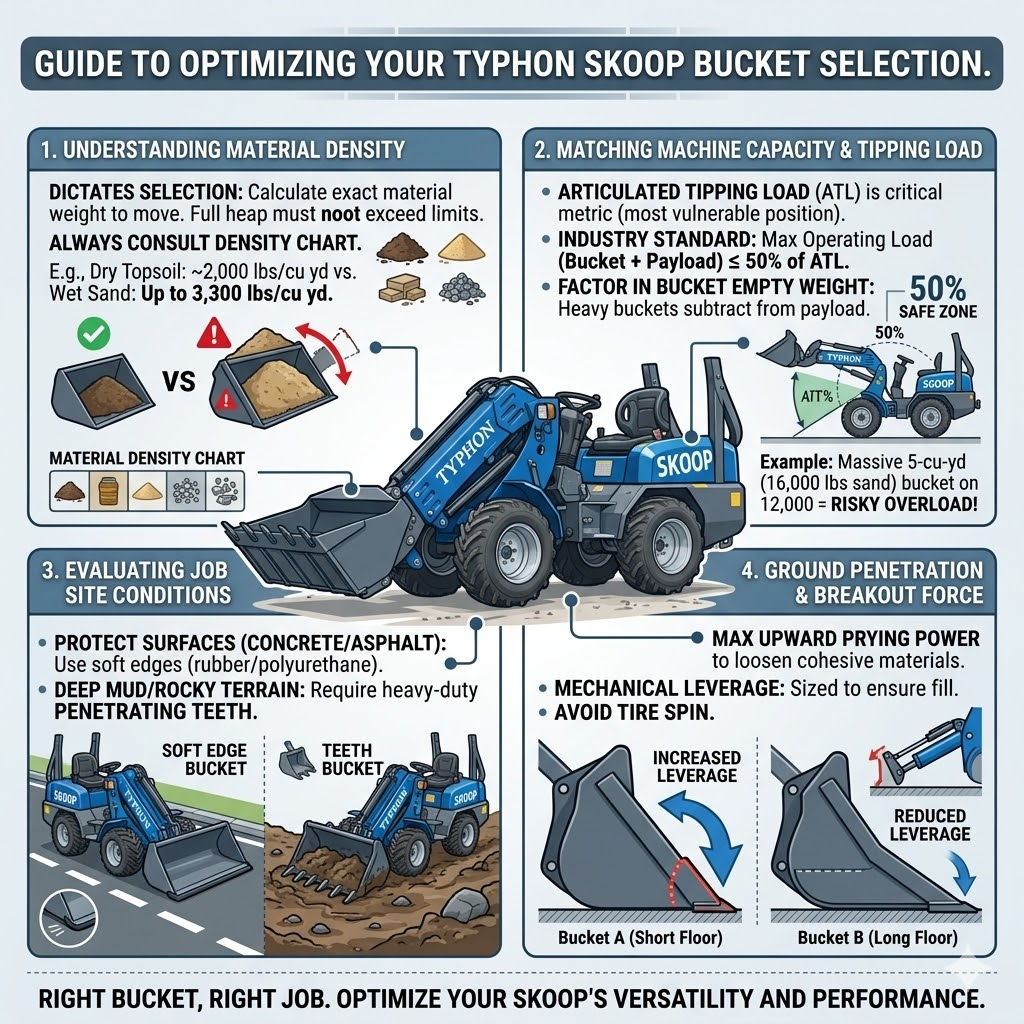
Material density dictates everything about bucket selection. You must calculate the exact weight of the material you intend to move. A cubic yard of dry topsoil weighs approximately 2,000 pounds. Up to 3,300 pounds can be found in a cubic yard of wet sand.
If you purchase a massive 5-cubic-yard bucket intending to move wet sand, you will be lifting over 16,000 pounds of material per pass. You have built an extremely risky and useless setup if your loader can only safely lift 12,000 pounds.
Always consult a material density chart. Identify the heaviest material your machine handles regularly and size your bucket capacity so that a fully heaped load never exceeds the machine’s rated operating limits. It is always better to make an extra pass with a properly sized bucket than to overload your equipment.
Matching Machine Capacity and Tipping Load
Every wheel loader comes with a manufacturer-specified “Straight Tipping Load” and a “Fully Articulated Tipping Load.” The fully articulated tipping load is the most important metric, as it represents the machine in its most vulnerable, unstable position—when it is turned sharply to the left or right.
As a strict industry standard, your maximum operating load (the weight of the bucket plus the weight of the material inside it) should never exceed 50% of the machine’s fully articulated tipping load. This 50% buffer ensures the loader remains firmly planted on the ground, even if the operator bounces over a rut or drops a tire into a small depression while carrying a heavy load.
When choosing the right bucket, you must factor in the empty weight of the bucket itself. Heavy-duty rock buckets and multi-purpose buckets contain significantly more steel than standard buckets. This extra attachment weight subtracts directly from the amount of payload you can safely carry.
Evaluating Job Site Conditions
The physical environment of your work area plays a major role in bucket selection. If you operate on concrete or finished asphalt, you must protect the surface from damage. In these scenarios, you should equip your bucket with a bolt-on rubber or polyurethane cutting edge. These soft edges squeegee the surface clean without leaving deep gouges or destroying painted parking lot lines.
Conversely, if you operate in deep mud, heavily compacted clay, or rocky terrain, a smooth cutting edge will simply slide over the top of the ground. You need a bucket equipped with heavy-duty penetrating teeth to break through the surface tension and fill the bucket completely.
Ground Penetration and Breakout Force
Breakout force measures the maximum upward power the loader can exert at the bucket’s cutting edge to pry material loose. If you work with highly cohesive materials like dense clay or unbroken rock, you need to maximize your breakout force.
To achieve this, choose a bucket with a shorter floor length. A shorter bucket floor brings the cutting edge closer to the machine’s hinge pin, giving the hydraulic cylinders greater mechanical leverage. While a shorter floor slightly reduces the bucket’s total holding capacity, the increased digging power ensures the operator can easily fill the bucket rather than spinning the tires trying to push into a stubborn pile.
Bucket Edges and Teeth Options
The cutting edge of your bucket engages with the material before any other part of the machine. Customizing this leading edge drastically improves performance and extends the lifespan of the attachment.
Bolt-On Cutting Edges (BOCE)
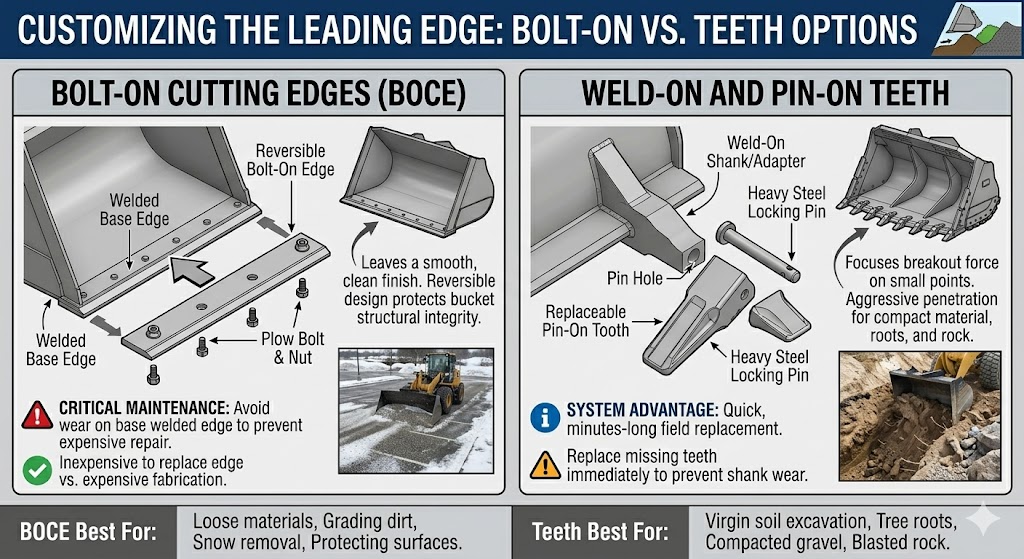
A bolt-on cutting edge is a replaceable strip of hardened steel that bolts directly over the bucket’s welded base edge. As the bucket drags across concrete, gravel, or abrasive soil, this bolt-on edge takes all the wear.
Once the edge wears down, your operators simply unbolt it, flip it over (as they are usually double-sided), and bolt it back on. When both sides are worn, you replace the relatively inexpensive edge. Using a BOCE protects the permanent structural integrity of the bucket. If you allow the base welded edge to wear away, you will face an incredibly expensive welding and fabrication repair.
Bolt-on edges are ideal for handling loose materials, grading dirt, and snow removal, as they leave a smooth, clean finish behind the machine.
Weld-On and Pin-On Teeth
When you need to excavate virgin soil, rip through tree roots, or penetrate blasted rock, a smooth edge will fail. You must equip the bucket with ground-engaging teeth.
Teeth focus the loader’s entire pushing force onto a few small, sharp points, easily fracturing compacted material. Most modern buckets utilize a pin-on tooth system. Heavy steel shanks are welded directly to the bucket edge. Replaceable cast-steel teeth slide over these shanks and are locked in place with a heavy steel pin.
When the teeth wear dull, operators can easily hammer the pins out and install fresh teeth in minutes. Always replace missing or broken teeth immediately. Operating a bucket with a missing tooth exposes the welded shank to rapid wear, which requires a professional welder to repair.
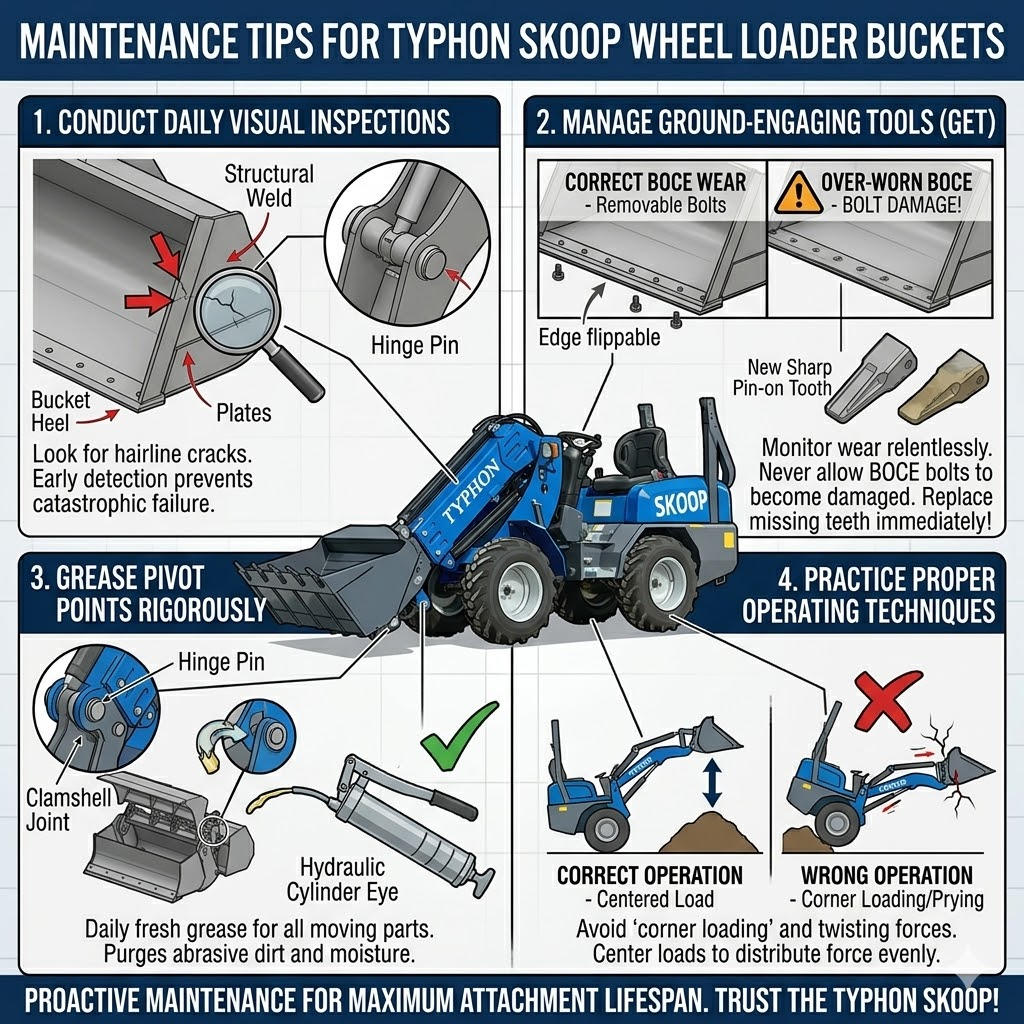
Maintenance Tips for Wheel Loader Buckets
Protecting your equipment investment requires proactive maintenance. While wheel loader buckets possess incredible strength, they are not indestructible. Implement these heavy equipment care strategies to maximize the lifespan of your attachments.
1. Conduct Daily Visual Inspections
Train your operators to inspect the bucket during their daily morning walkaround. They should look for hairline cracks in the structural welds, particularly around the hinge pin, plates, and the bucket heel. Catching a small crack early allows for a quick, inexpensive weld repair before the bucket tears completely apart under a heavy load.
2. Manage Ground-Engaging Tools
Monitor the wear on your cutting edges and teeth relentlessly. Never allow a bolt-on edge to wear down so far that the bolts themselves become damaged. If the bolt’s heads grind away, removing the edge becomes a massive, time-consuming chore requiring cutting torches.
3. Grease Pivot Points Rigorously
If you utilize multi-purpose buckets, side-dump buckets, or high-dump buckets, you introduce moving hydraulic parts to the attachment. Every hinge pin and hydraulic cylinder eye must receive fresh grease daily. Pushing clean grease into the joint purges highly abrasive dirt, sand, and moisture out of the bushings, preventing premature metal-on-metal wear.
4. Practice Proper Operating Techniques
Operator behavior dictates bucket lifespan. Train your operators to avoid “corner loading”—trying to pry out a massive boulder using only one corner of the bucket. This exerts severe twisting forces on the loader’s lift arms and can easily crack the bucket frame. Operators should always attempt to center heavy, stubborn loads to distribute the force evenly across the machine.
Conclusion
Understanding bucket types for wheel loaders is an essential component of professional fleet management. The attachment you choose directly dictates your machine’s productivity, your operator’s safety, and your company’s daily profitability.
By carefully analyzing your standard material densities, accurately calculating your machine’s tipping limits, and aligning those metrics with the correct bucket profile, you guarantee maximum efficiency on every job site. Whether you rely on the versatility of a general-purpose bucket, the high capacity of a light material bucket, or the unmatched toughness of a rock bucket, the right tool makes all the difference.
We encourage you to review your current fleet capabilities today. Evaluate your upcoming project requirements and seek advice from a certified equipment dealer to guarantee your wheel loaders come with the best buckets. Investing time into choosing the right bucket secures reliable, profitable performance from your heavy machinery for years to come.