
Wheel Loader Attachments: Complete Buying Guide
Heavy machinery is a significant financial investment for any contracting business. To generate a strong return on investment, your equipment must perform consistently and reliably throughout each phase of your project. A wheel loader is a powerful asset, but its true value emerges when used with the right tools.
By using specialized wheel loader attachments, you can convert a standard earthmover into a versatile multi-purpose machine. This adaptability reduces your reliance on a large fleet of single-purpose equipment, lowering overall operating expenses while maintaining crew productivity.
This guide examines the most effective attachments available today, dives into the economics of attachment management, and explains how to match them to your job site needs. Whether you work in construction, agriculture, road maintenance, or material handling, selecting the appropriate attachment is critical to maximizing efficiency.

Driving Construction Equipment Versatility
Efficiency on a job site depends on completing tasks safely, accurately, and on schedule. Modern projects often require operators to switch between multiple tasks—loading materials, transporting goods, and cleaning work areas—all within the same day.
Wheel loaders provide the raw hydraulic power and lifting strength needed for demanding work. However, attachments are what truly unlock their versatility. With the right tools, a single machine can replace several specialized pieces of equipment.
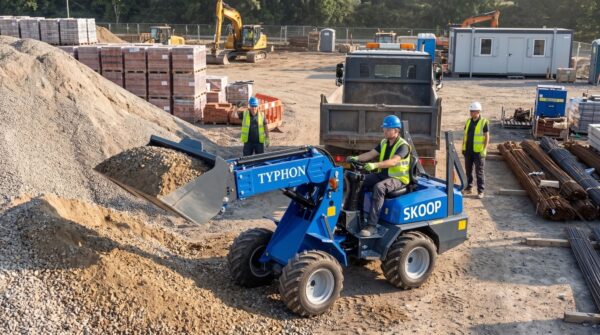
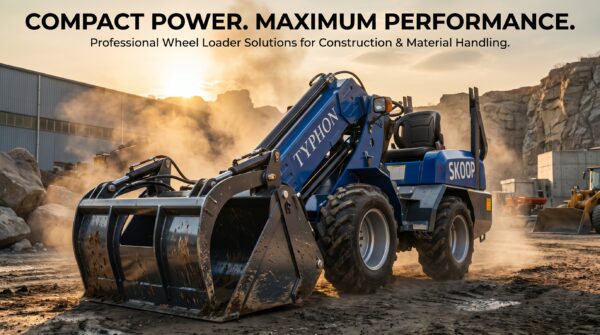
For example, the TYPHON SKOOP Wheel Loader is designed to handle a wide range of attachments efficiently. Its compact size combined with a telescopic arm allows it to operate in tight spaces while still delivering strong lifting performance. This makes it ideal for operators who need flexibility without sacrificing power.
By using attachments strategically, businesses can take on more diverse projects, bid on complex contracts, reduce equipment downtime, and drastically increase overall productivity.

The Foundation: Essential Wheel Loader Attachments
Certain attachments are the lifeblood of daily operations. These tools form the foundation of efficient material handling and should be part of almost every fleet.
Buckets: The Earthmoving Standard
The bucket is the most widely used attachment for wheel loaders. While it may seem simple, selecting the right type of bucket can significantly impact performance, fuel efficiency, and machine longevity.
- General-Purpose Buckets: Ideal for everyday tasks such as moving soil, sand, and gravel. They provide a balanced combination of capacity and strength, making them suitable for most job sites.
- Light Material Buckets: Designed for low-density materials like mulch, snow, or grain. Their larger capacity allows operators to move more material in fewer cycles, improving efficiency.
- Rock Buckets: Built for heavy-duty durability. Reinforced edges, thicker steel plating, and heavy-duty teeth allow them to handle abrasive materials such as rocks, quarry stone, and demolition debris without excessive wear.
- Multi-Purpose (4-in-1) Buckets: These offer exceptional flexibility. They can function as a standard bucket, dozer blade, grapple, and scraper. The 4-in-1 bucket is a revolutionary tool for contractors who require a quick transition from digging to grading.
Choosing the correct bucket improves productivity and protects your machine’s loader arms and hydraulic cylinders from unnecessary strain.
Pallet Forks: Mastering Material Logistics
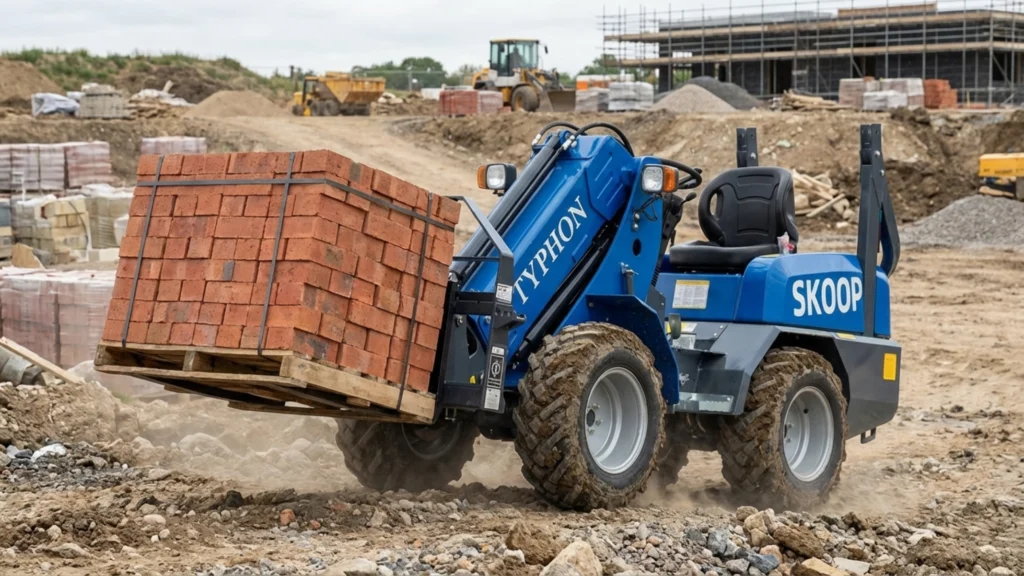
Moving beyond loose materials, many job sites require handling palletized goods such as bricks, cement blocks, lumber, and packaged supplies. Pallet forks transform a wheel loader into a powerful, all-terrain forklift.
Unlike traditional warehouse forklifts that are limited to smooth concrete surfaces, a wheel loader equipped with forks can operate efficiently on rough terrain, deep mud, gravel, and uneven construction sites. Operators can unload delivery trucks quickly, transport materials across massive sites and place them precisely where they are needed.
When selecting pallet forks, it is important to consider the length and strength of the tines. Heavy-duty forged forks are ideal for handling substantial loads without bending. Advanced systems also include hydraulic fork positioning, allowing operators to adjust fork width directly from the cab, saving valuable time.
For compact machines like the TYPHON SKOOP, pallet forks are especially valuable. Its telescopic reach allows operators to place loads at greater heights or over obstacles—such as reaching across a flatbed truck or placing pallets over a retaining wall—making it highly effective in confined spaces.

Grapples: Taming Bulky and Irregular Loads
Standard buckets are not suitable for handling loose, bulky, or irregular materials. Items such as logs, brush, scrap metal, and demolition debris can easily spill out, creating safety risks and inefficiencies. Grapples solve this problem by using hydraulic arms to clamp down securely on the material.
- Root/Brush Grapples: Commonly used in land clearing and landscaping. The tined design allows loose soil and small rocks to fall through while firmly gripping larger materials like roots, stumps, and branches.
- Scrap/Demolition Grapples: Ideal for recycling centers and demolition sites, featuring solid bottoms and powerful clamps to crush and secure jagged metal, concrete chunks, and structural waste.
- Log Grapples: Used in forestry and lumber yards, featuring curved arms that wrap around and securely hold large logs or pipes during transport.


Advanced and Niche Job Site Attachments
As your business grows, so do the demands of your contracts. Expanding your attachment inventory into niche categories allows your wheel loader to step into roles traditionally reserved for dedicated, expensive machinery.
Hydraulic Breakers and Hammers
When you hit solid rock or need to tear up concrete foundations, a bucket won’t suffice. Hydraulic breakers turn your loader into a mobile demolition unit. Powered by the machine’s auxiliary hydraulics, these attachments deliver rapid, high-impact blows to fracture concrete, asphalt, and rock. Because wheel loaders are highly mobile, using a breaker on a loader is incredibly efficient for road repair and selective demolition.
Cold Planers and Asphalt Milling Tools
For municipal contractors and roadwork crews, cold planers (or asphalt millers) are essential. These attachments grind away top layers of asphalt or concrete, leaving a textured, flat surface ready for repaving. When paired with a continuous-flow hydraulic system, a wheel loader can repair potholes, smooth out frost heaves, and mill around manholes much faster than manual crews.
Trenchers
Laying irrigation lines, underground utilities, or drainage pipes usually requires an excavator or a dedicated walk-behind trencher. However, a trencher attachment on a wheel loader allows you to cut straight, deep, and clean trenches quickly. The weight of the loader provides excellent downward pressure, allowing the trencher teeth to bite into hard, compacted clay or rocky soil with ease.
Bale Spears and Agricultural Handlers
Wheel loaders aren’t just for construction; they are indispensable on large farms. Bale spears (both single and multi-tine configurations) are used to pierce and transport large round or square hay bales. Because wheel loaders have a higher lift capacity and better visibility than standard farm tractors, they make quick work of stacking bales in barns or loading them into feed mixers.

Augers: Precision Drilling Power
Augers are essential for tasks that require drilling vertical holes, such as installing fence posts, planting mature trees, or setting concrete footings. Powered by the loader’s hydraulic system, augers provide strong drilling torque with minimal manual effort. The weight of the wheel loader adds the necessary downward force to penetrate tough soil conditions.
For compact yet powerful machines like the TYPHON SKOOP, augers offer excellent control and visibility. The elevated cab position allows operators to align the drill accurately, ensuring precise, plumb results every time.

The Telescopic Boom Multiplier
While attachments add versatility, the geometry of the machine operating them dictates their ultimate usefulness. Traditional wheel loaders have a fixed loader arm, limiting their reach and dump height.
This is where machines like the TYPHON SKOOP Wheel Loader create a distinct operational advantage. Equipped with a telescopic boom, it acts as a force multiplier for every attachment it carries:
- Extended Reach: When using a bucket, a telescopic boom allows the operator to load materials into high-sided dump trucks or agricultural feed mixers that a standard compact loader cannot reach.
- Obstacle Clearance: When using pallet forks, the boom can extend across flatbed trailers, allowing the operator to load and unload an entire truck from one side, saving space and time in cramped yards.
Deep Placement: When using an auger, the boom can be extended over fences, retaining walls, or existing landscaping to drill holes without driving the machine directly onto delicate terrain.

Choosing the Right Tool: Key Operational Considerations
Selecting the right attachment requires a clear understanding of your machine’s physical and hydraulic capabilities. Making the wrong choice can lead to reduced efficiency, increased wear, and severe safety hazards. Focus on these three critical factors:
- Calculate Machine Lifting Capacity
Every wheel loader has a strictly defined safe working load limit. When selecting an attachment, you must calculate the combined weight of the attachment and the maximum weight of the material being lifted.
Heavier attachments, like scrap grapples or concrete breakers, significantly reduce the available payload capacity for the material itself. If the combined weight exceeds the loader’s limit, the machine can tip forward or suffer premature structural fatigue.
The TYPHON SKOOP provides a strong balance between compact size and power, with a rated load of 1,760 lbs and a maximum lifting capacity of up to 2,200 lbs using the main arm. Additionally, its 15KN breakout force ensures efficient lifting and prying performance, even in heavily compacted soil.

- Understand Hydraulic Flow Requirements
Attachments fall into two categories: non-powered (buckets, forks, spears) and powered (augers, sweepers, breakers). Powered attachments rely heavily on the loader’s auxiliary hydraulic flow, measured in gallons per minute (GPM) and pressure (PSI).
If your machine provides standard flow, it will run augers and sweepers perfectly. However, if you attach a high-flow tool (like a heavy-duty cold planer) to a standard-flow machine, the tool will stall, overheat the hydraulic fluid, and fail to perform. Always match the attachment’s required GPM to your machine’s output. The TYPHON SKOOP is specifically engineered to support a diverse array of standard hydraulic attachments, ensuring smooth, uninterrupted operation.
- Assess Material Type and Density
Different materials place different demands on your equipment. Wet sand, gravel, and wet snow are incredibly dense. Filling a massive light-material bucket with wet gravel will instantly overload the machine. Conversely, using a small, heavy-duty rock bucket to move dry wood chips wastes time and fuel. Always size the bucket volume to the density of the material you handle most frequently. With its versatile 0.3 cbm bucket and 30% gradeability, the TYPHON SKOOP handles dense materials effortlessly, even on steep, uneven terrain.

The Advantage of Quick-Attach Systems
In the past, changing attachments was a time-consuming, physically demanding, and dangerous process. Operators had to manually hammer out steel pins, perfectly align heavy components, and wrestle with pressurized hydraulic hoses. Because of this hassle, operators would often use the wrong tool for the job simply to avoid changing it.
Modern quick-attach systems have revolutionized this process. With a universal hydraulic quick coupler, operators can switch from a bucket to pallet forks in seconds, often without leaving the cab.
- Increased Productivity: Downtime between tasks is reduced from 20 minutes to 30 seconds.
- Improved Safety: Eliminates pinched fingers, crushed toes, and back strains associated with manual equipment swapping.
- Better Workflow: Because switching is effortless, operators are guaranteed to use the correct tool for the specific task, preserving the machine and doing the job right.
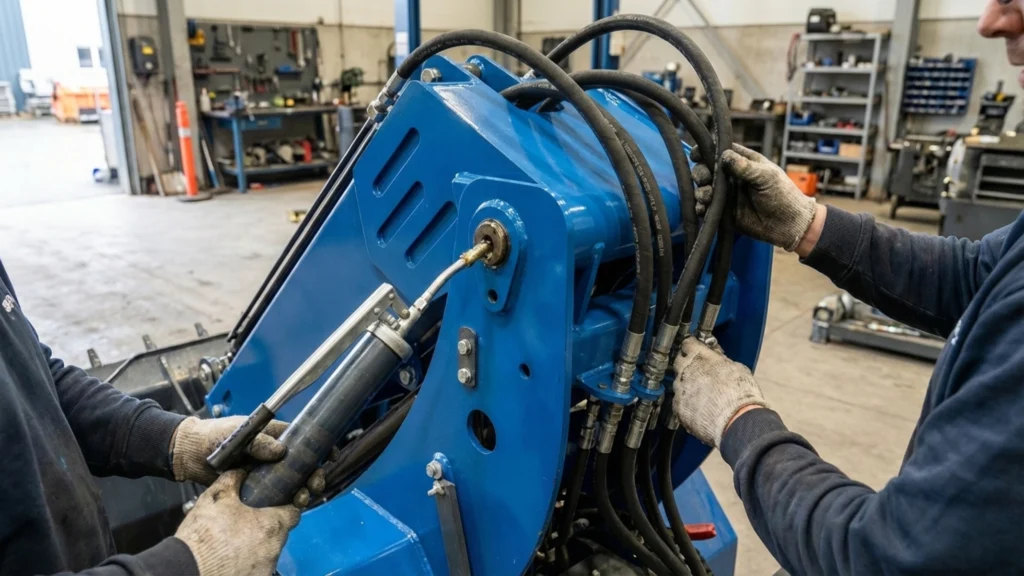
Attachment Maintenance and Longevity Best Practices
Attachments are subjected to the harshest abuse on the job site. To ensure they last as long as the machine itself, strict maintenance protocols must be followed:
- Daily Grease Intervals: Attachments like grapples and 4-in-1 buckets have multiple pivot points. These must be greased daily to push out dirt and prevent metal-on-metal wear.
- Inspect Hydraulic Hoses: Before connecting powered attachments, inspect the hydraulic lines for chafing, cracks, or leaks. A blown high-pressure line can shut down a site and cause environmental hazards.
- Check Wear Parts: Bucket teeth, cutting edges, and sweeper bristles are consumable wear parts. Replace them before they wear down to the attachment’s structural weldments. Replacing a bolt-on cutting edge costs a few hundred dollars; replacing a worn-out bucket base costs thousands.
- Keep Couplers Clean: Dirt in hydraulic flat-face couplers will contaminate your loader’s entire hydraulic system. Always wipe couplers clean with a rag before connecting them.
Safety Protocols for Attachment Operation
Adding an attachment fundamentally changes the physics of your wheel loader. Operators must be trained on these changing dynamics:
- Center of Gravity Shifts: Extending a telescopic boom or lifting a heavy load with pallet forks moves the machine’s center of gravity forward and upward. Always travel with loads as low to the ground as possible to prevent tipping.
- Line of Sight: Bulky attachments like sweepers or high-capacity buckets can obscure the operator’s forward vision. Be aware of blind spots and use spotters in congested areas.
- Hydraulic Pressure Release: Never attempt to disconnect hydraulic hoses while the system is pressurized. Always shut off the engine and cycle the auxiliary controls to relieve pressure before disconnecting.
The Economics: Should You Rent or Buy Attachments?
As you recognize the need for more attachments, the question becomes: Do I buy them or rent them?
The answer lies in your utilization rate.
- Buy: If you use an attachment (like pallet forks or a general-purpose bucket) more than 60% of your working days, purchasing is the most cost-effective route. The ROI is usually realized within the first year.
- Rent: If you need a specialized attachment (like a cold planer or an extra-large snow pusher) for a specific, short-term contract, renting prevents you from tying up capital in tools that will sit idle in your yard for 11 months of the year.
Secure Your Job Site Efficiency
Maximizing efficiency on a job site requires more than just powerful equipment—it requires a strategic arsenal of tools.
Wheel loader attachments allow you to unlock the full potential of your capital investment. From handling bulk materials with specialized buckets to improving logistics with forks, clearing land with grapples, and drilling foundations with augers, every attachment transforms your loader into a new revenue-generating asset.
Machines like the TYPHON SKOOP Wheel Loader demonstrate exactly how compact modern loaders deliver both power and extreme versatility in a single platform. With its telescopic arm, robust lifting capacity, and seamless compatibility with a massive range of attachments, operators can complete more work, bid on more diverse jobs, and scale their businesses without buying an entire fleet of specialized machines.
By carefully evaluating your daily needs, understanding your machine’s capabilities, and implementing proper maintenance routines, you can drastically reduce operational costs and maintain a safer, more efficient job site. Taking a strategic approach to your attachments doesn’t just protect your investment—it ensures your business stays competitive, agile, and highly profitable for years to come.